
Categories
Latest Posts
Tags
Advertising Amazon Amazon Advertising Amazon Experts Amazon Listing Optimization Amazon Marketplace Amazon News Amazon Prime Amazon Professional Sellers Summit Amazon Seller amazon sellers Amazon Seller Tips Amazon Seller Tools ASIN Brand Management Brands Buy Box Campaign Manager Consumer Trends COVID-19 downloadable Dynamic Pricing Ecommerce FBA FBM Holiday Season industry news Multi-Channel Fulfillment Optimize pay-per-click Pricing Algorithm Pricing Software Private Label Profits Repricing Repricing Software Revenue Sales Seller Seller-Fulfilled Prime Seller Performance Metrics SEO SKU Sponsored Products Ads Strategy
Get the latest insights right in your inbox
Resource | Blog
Amazon’s 2027 Fee Changes: The Average Increase Isn’t Your Increase
- November 13, 2026
By: Matt Visone, Director of Customer Success, Feedvisor
TLDR
- Amazon’s 2027 US fee changes start January 15. FBA fulfillment fees rise $0.19 per unit on average, more than double last year’s $0.08 increase.
- The average hides the spread. Small items priced over $50 pay about $0.70 more per unit, and aged inventory costs more starting February 1.
- The changes have implications beyond fulfillment costs. Fees now affect pricing, ad targets, and purchase orders together. Update all three before the new rates take effect.
- Feedvisor is offering a 2027 fee impact analysis that shows which of your SKUs are hit hardest and what to change.

Matt Visone
Director of Customer Success, Feedvisor
Every year, Amazon's fee announcement lands in the middle of Q4. Brands are deep in Black Friday and Cyber Monday, and the update is easy to skim and file for later.
This year, I'd push back on that instinct.
On November 5, Amazon announced its 2027 US fee changes. The headline figure is an average FBA increase of $0.19 per unit. That sounds manageable. But across the brands my team works with, an average is rarely what anyone actually pays. The real impact depends on your price points, your size tiers, and how old your inventory is. For some catalogs, 2027 will cost meaningfully more than the headline suggests.
Here's what is changing, where the costs concentrate, and what I'd do before January 15.
What's changing, and when
The changes roll out in three waves, from mid-January through March. FBA fulfillment fees rise by $0.19 per unit on average, about 0.8% of the average selling price. That's more than double the $0.08 increase in 2026.
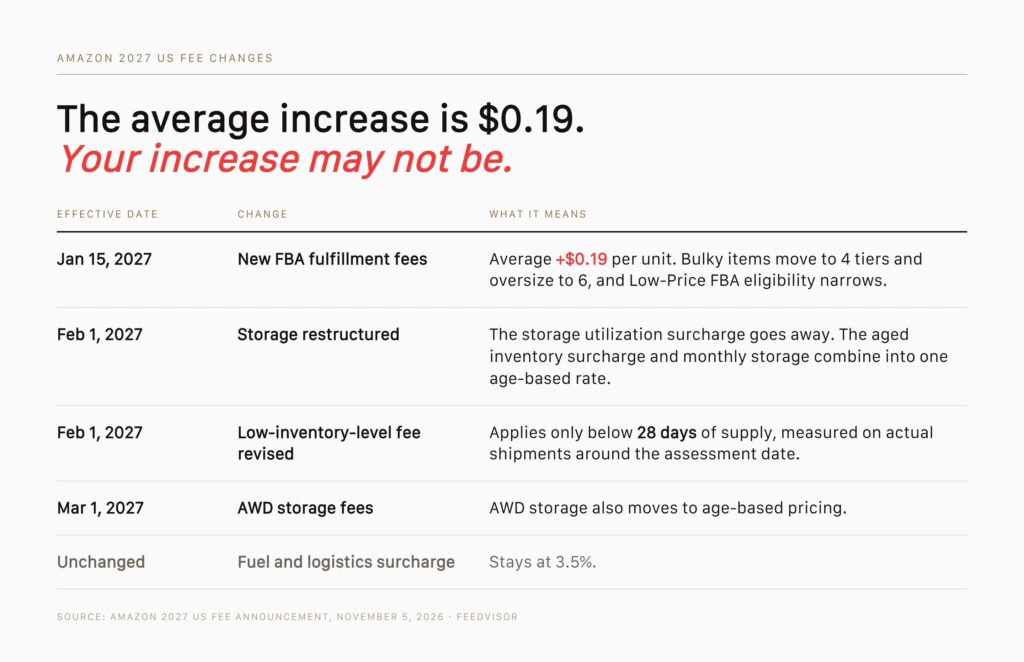
One timing note: holiday peak fulfillment fees run through January 14, 2027, so the new rates take over the very next day.
Why the average isn't your number
The $0.19 is spread across every unit Amazon fulfills, and the increase isn't even across that range. The biggest jumps fall on small items priced over $50, which will pay about $0.70 more per unit.
That matters most for premium brands. A compact, high-ticket product line is exactly the catalog that tends to look healthy on paper and then lose margin quietly.
The storage change works the same way. If your inventory sells within six months, you should pay the same or less than today. If you're holding aged stock, whether it's slow movers, overbought seasonal items, or a bet on a launch that didn't land, your costs go up starting February 1.
So two brands generating the same revenue could face very different fee increases depending on their product mix, price points, and inventory turnover.
Consider a brand selling 100,000 units annually across its Amazon catalog. At the average $0.19 increase, that's $19,000 in additional fulfillment costs. But if a meaningful portion of those sales comes from premium, compact products facing increases closer to $0.70, the impact could be considerably higher.
And that's before accounting for changes to inventory storage costs.
A fee change is never just a fee change
The mistake I see most often is treating fees as an accounting line that finance reconciles after the fact. In reality, a fee change moves three decisions at once.
Pricing. When a SKU's cost to fulfill goes up, its break-even price goes up too. If your repricing rules still use 2026 costs, they can push products below profitable levels without anyone noticing.
Advertising. A higher fulfillment cost reduces the contribution margin available to fund customer acquisition. That means a campaign can deliver exactly the same ROAS in February as it did in December, yet generate less profit or even become unprofitable. Brands need to revisit break-even ACoS and reassess where to invest their advertising dollars. Products that supported profitable growth in 2026 may warrant different levels of investment in 2027 as their economics change.
Inventory. Age-based storage fees increase the cost of holding slow-moving inventory, making replenishment decisions even more consequential. Brands need to balance the cost of excess inventory against the risk of stockouts, lost sales, and reduced organic visibility.
What to do before January 15
Here's the order I'd work in.
- Model the change SKU by SKU. Amazon has added a Fee Change Comparison dashboard to Profit Analytics in Seller Central. Start there and sort by dollar impact, not percentage.
- Flag premium, compact products. Small items priced over $50 take the largest per-unit increase. Check their margins first.
- Reset price floors. Update the minimum prices in your repricing rules so they reflect 2027 costs before the new rates go live.
- Recalibrate ad targets. Recalculate break-even ACoS for every SKU whose fees change, then adjust bids, budgets and investment priorities based on each product’s updated profitability before January 15.
- Right-size Q1 purchase orders. Know which products are close to aging out before February 1. Plan sell-through or removals for those, and keep healthy products above 28 days of supply.
- Revisit bulky and oversize products. The new tier structure may move some products into a different tier. Confirm where each one lands and update the associated fulfillment costs in your profitability calculations.
How we're helping brands plan for 2027
On my team, we treat fee changes as a reason to look at the whole business, not just a line item to update. With Agentis, we connect pricing, advertising, inventory, and product economics so brands can respond to changes in fulfillment costs across the business. When a product's margin changes, that should inform not only its price floor, but also how aggressively to advertise it and how much inventory to carry.
As Amazon's fee structure evolves, understanding profitability at the product level becomes increasingly important. The opportunity is to use that visibility to make better decisions about where to invest, where to adjust, and how to drive profitable growth.
To help brands prepare, we're offering a 2027 fee impact analysis. We'll show you which products the changes hit hardest, where your current pricing and ad targets no longer add up, and what to adjust before January 15.
With the new rates taking effect immediately after the holiday peak period, now is the time to assess your exposure and make the necessary adjustments. Reach out to request your analysis.
Sources
- Amazon 2027 FBA fee changes: $0.19 more per unit from January 15 (NovaData)
- Amazon sellers face average $0.19 FBA fee rise from January 15, 2027 (PPC Land)
- Amazon FBA fee changes for 2027 (GOAT Consulting)
- Amazon to increase shipping and logistics fees in 2027 (Chain Store Age)