
Categories
Latest Posts
Tags
Advertising Amazon Amazon Advertising Amazon Experts Amazon Listing Optimization Amazon Marketplace Amazon News Amazon Prime Amazon Professional Sellers Summit Amazon Seller amazon sellers Amazon Seller Tips Amazon Seller Tools ASIN Brand Management Brands Buy Box Campaign Manager Consumer Trends COVID-19 downloadable Dynamic Pricing Ecommerce FBA FBM Holiday Season industry news Multi-Channel Fulfillment Optimize pay-per-click Pricing Algorithm Pricing Software Private Label Profits Repricing Repricing Software Revenue Sales Seller Seller-Fulfilled Prime Seller Performance Metrics SEO SKU Sponsored Products Ads Strategy
Get the latest insights right in your inbox
University | Amazon Advertising
What Is Agentic Commerce for Brands?
Definitions, Examples, and How It Works on Amazon
Published: May 20, 2026

Dani Nadel
Dani is a recognized marketing and digital expert with more than 20 years of hands-on experience managing nationally recognized consumer and corporate brands. Before joining Feedvisor, Dani was the Chief Digital Marketing Officer, Clubs, and Commerce at Scholastic, where she led the company’s digital division and the initiative to transition to technology-enabled reading.
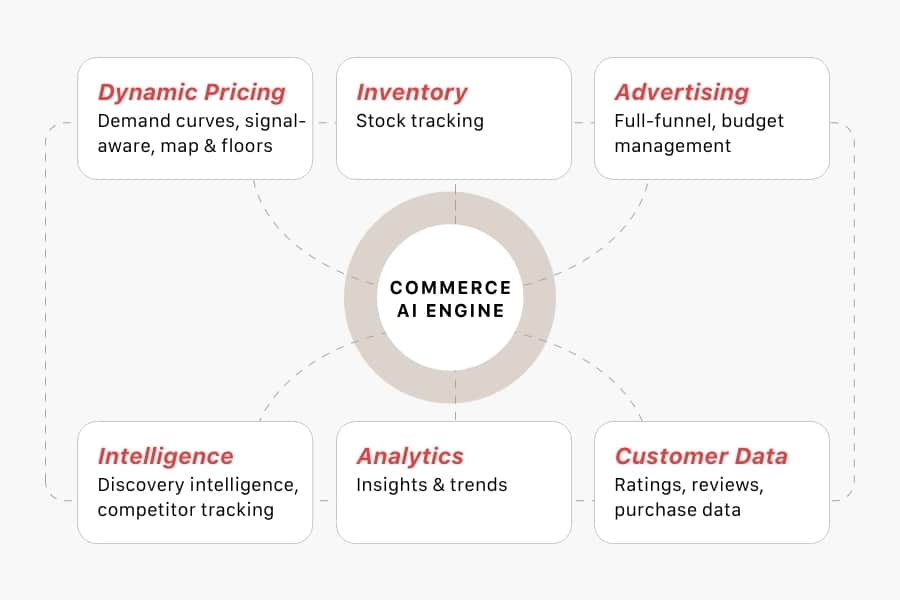
The term is everywhere in 2026. Here’s what agentic commerce actually means for brands, why it’s different from legacy AI optimization, and how to evaluate it on Amazon.
Key takeaways:
- Agentic commerce for brands uses agentic AI to coordinate decisions across advertising, pricing, inventory, and competitive strategy in real time
- It differs from traditional AI optimization, which improves performance within individual channels but still operates in silos
- The shift changes what brands optimize for: contribution margin instead of ROAS
- Brands that adopt this architecture early can build an advantage that compounds
Agentic Commerce Has Two Sides. Most People Only Know One.
If you’ve followed the commerce conversation in the last year, you’ve seen “agentic commerce” everywhere.
Google is building AI shopping agents. OpenAI has released an Agentic Commerce Protocol that Shopify has integrated with. Amazon’s “Buy for Me” feature lets AI complete purchases on behalf of consumers.
These are all consumer-facing applications: AI agents that shop for you, compare prices, and complete checkout. That’s one side of the story.
But increasingly, the term is also being used to describe something very different: AI systems that operate commerce for brands.
These systems don’t transact for shoppers. They operate the commerce engine itself.
That’s agentic commerce for brands. And it’s a fundamentally different category than “AI shopping assistants.”
What Is Agentic Commerce for Brands?
Agentic commerce for brands is a model in which AI systems autonomously make coordinated decisions across the full commerce operation.
Not just better recommendations. Not just faster reports. Actual decisions, executed in real time, across advertising, pricing, inventory, and competitive strategy.
In this model, the system doesn’t just optimize one metric in one channel. It optimizes the business itself.
Platforms like Agentis by Feedvisor are built around this architecture for Amazon brands: a unified decision engine that continuously reads signals, reasons about tradeoffs, and acts across levers at once. Feedvisor has spent more than a decade building optimization technology for brands on Amazon, with more than $50 billion in commerce activity managed through its platform.
How Agentic Commerce Is Different from Upgrading the Stack
Most Amazon brands have already moved from rules-based automation to AI optimization. That shift improved performance within each channel. Agentic commerce is a different kind of shift, one that changes what optimization itself means.
Rules-Based Automation | AI Optimization | Agentic Commerce | |
How it works | If/then instructions written by humans | ML optimizes within one channel | AI reasons and acts across channels |
What it sees | Predefined triggers | Single-channel data | Full state of the business |
What it does | Executes rules | Improves channel performance | Coordinates decisions across functions |
Optimizes for | Rule compliance | Channel metrics (ROAS, CPC) | Business outcomes (contribution margin) |
Limitation | Can’t adapt to new conditions | Optimizes in silos | Emerging operational model |
Example outcome | Reactive responses | Better individual metrics | Coordinated business performance |
AI Optimization
AI optimization is the current generation. Machine learning models analyze campaign data and make smarter bid adjustments, better keyword recommendations, and more efficient budget allocations. These are genuinely better than rules-based systems.
But they still operate within a single channel. Your ad platform’s AI optimizes your ads. It has no visibility into your pricing, your inventory, your margins, or what your competitors just did.
Agentic Commerce
Agentic commerce is the next step. A system that reads signals across the business, reasons about the relationships between them, and acts across multiple levers simultaneously. It doesn’t just optimize one channel. It coordinates decisions across the entire operation.
The difference isn’t incremental. It’s architectural.
Why This Matters Now: The Coordination Problem
Amazon’s advertising business added over $12 billion in incremental revenue in 2025 alone. Brands are spending more, executing better, and measuring more carefully than ever. And yet, on the bottom line, the picture is different. Margins are compressing.
The issue isn’t the tools. Each one is doing its job. The issue is what happens between them.
Consider how decisions actually flow through a typical Amazon operation. The ad platform sees clicks, impressions, and ROAS. The pricing tool sees competitor data and Buy Box dynamics. The inventory system sees velocity and replenishment timing. Each one operates from a different version of the business, and none of them share a complete view.
When the market moves, each system responds to what it can see. The ad platform pushes harder when conversion slows, not realizing that pricing has shifted. The pricing engine adjusts to competitor moves without knowing that ad spend just doubled. Inventory plans against demand signals that have already been distorted by both.
The decisions are individually rational. The collective outcome is not. Disconnected optimization creates disconnected outcomes.
This is why brands can invest in best-in-class tools across every function and still find that their P&L tells a different story than their dashboards. The problem isn’t any individual tool. It’s that none of them were built to share context with the others.
Agentic commerce closes that gap by creating a shared decision layer that coordinates how decisions interact across the business.
What Agentic Commerce Looks Like in Practice
The clearest way to understand agentic commerce is to walk through what happens when a real shift hits an Amazon business, and how the architecture changes the response.
Consider a search trend developing in your category. A new keyword starts gaining volume. Competitors begin bidding on it. Conversion patterns are shifting toward this term.
In a disconnected setup, here’s what happens:
- The ad platform’s keyword harvester eventually picks up the trend and proposes new targets, often days after the shift began
- The pricing tool has no awareness of the new search behavior at all
- The inventory system continues forecasting based on historical demand patterns
- Margin and competitive dynamics never enter the bid optimization model
By the time a human notices and coordinates a response across these systems, the trend has either matured or moved on.
In an agentic commerce platform, the same triggers play out differently:
- The system identifies the rising search term as it gains volume
- It cross-references inventory depth on the ASINs most relevant to that term
- It evaluates whether margin structure supports aggressive bidding at current price points
- It looks at competitor positioning and Buy Box dynamics on those ASINs
- It raises bids on the new term, reallocates budget from lower-performing terms, and adjusts price if needed to protect conversion economics
All of this happens in real time, against a shared view of the business.
The speed matters, but speed isn’t the only point. The point is every decision is made with the full context of every other decision. The bid is informed by margin. The price is informed by the bid. The budget shift is informed by inventory and competitive position.
Disconnected tools can’t operate this way because they don’t have access to the information they would need to do so. Agentic commerce isn’t faster than coordinated human work. It’s something humans coordinating multiple tools structurally can’t replicate.
The Metrics That Change Everything
Every commerce tool optimizes for something. The problem is that none of them optimize for the business.
Advertising platforms optimize for ROAS, ACoS, and CPC efficiency. Pricing systems optimize for Buy Box ownership and price competitiveness. Inventory systems optimize for forecast accuracy and replenishment timing. Each system is doing its job correctly. The issue is that none of these objectives represent the economic outcome of the business itself.
That distinction used to be manageable. Channels operated independently enough that optimizing each separately produced reasonable aggregate results. That is no longer true.
Commerce on Amazon is now too interconnected for independent optimization to work. A pricing decision affects conversion. Conversion shapes advertising efficiency. Advertising spend changes inventory velocity. Each system affects the others, whether the tools managing them recognize it or not.
The result is that brands can improve every individual metric and still see business performance decline. Marketing efficiency improves while contribution margin shrinks. Buy Box win rates climb while pricing power erodes. Demand scales while inventory destabilizes.
Strong returns can mask unprofitable growth, until the P&L catches up.
Agentic commerce changes the model. Instead of optimizing each function against its own metric, the system optimizes business outcomes across the operation.
The question shifts from “What is our marketing efficiency?” to “What is our contribution margin at this level of spend?”
Contribution margin is a business metric. It reflects advertising spend, Amazon fees, shipping costs, product margins, pricing pressure, inventory dynamics, and competitive intensity. It tells brands whether growth is economically productive, not just whether advertising became more efficient.
When contribution margin becomes the optimization objective, every decision in the system can be evaluated against the same standard. Bids are weighed against prices. Prices are weighed against inventory. Budgets are weighed against the competitive landscape.
That is the architectural difference. Agentic commerce isn’t a faster version of channel optimization. It’s a different model entirely.
Five Questions to Evaluate Any Agentic Commerce Platform
“Agentic commerce” is quickly becoming overloaded. It’s applied to AI shopping assistants, autonomous purchasing agents, conversational commerce, and traditional optimization platforms with new branding.
For brands evaluating commerce technology, the distinction matters. Here are five questions to ask any vendor claiming to offer agentic commerce on Amazon.
- Does it connect advertising and pricing in the same decision engine?
If advertising and pricing decisions are made by separate systems, you don’t have agentic commerce. You have two tools from the same vendor. The decisions need to share the same real-time state of the business.
- Does it see inventory, margin, and competitive signals in real time?
An agentic system must ingest signals beyond campaign data. If it only sees clicks, impressions, and ROAS, it’s an ad optimizer, not an agentic commerce platform. Look for real-time integration with:
Pricing and margins
Inventory levels
Competitive positioning
Fee structure and costs
- Does it act autonomously, or just recommend?
Recommendations require humans to evaluate and execute. Agentic commerce means the system reasons and acts.
On Amazon, market conditions change faster than human teams can respond: competitor price drops, search shifts, inventory swings. A system that recommends is helpful. A system that acts is transformative.
- Does it optimize for profit, not just ad efficiency?
If the primary optimization target is ROAS or ACoS, the system is built for advertising performance. Agentic commerce optimizes for business outcomes: contribution margin, unit economics, and total profitability.
- Does the intelligence compound over time?
An agentic system should get smarter about your specific business the longer it runs. Every decision generates an outcome. Every outcome is a signal.
Over time, the model should calibrate to your category, your competitive dynamics, and your margin structure. This compounding effect is what creates durable advantage.
Why Agentic Commerce Matters for Amazon Brands
Most of the public conversation about agentic commerce focuses on the consumer side. That layer will matter. But for brands on Amazon, the more immediate transformation is operational.
Commerce has become too dynamic, too interconnected, and too competitive to manage through disconnected systems. Advertising, pricing, inventory, and competitive intelligence need to operate as one system, not four separate tools making four separate decisions.
Brands that adopt agentic commerce early will build an advantage that compounds over time. Not just better ads. Better economics.
Frequently Asked Questions
What is agentic commerce?
Agentic commerce is a model in which AI systems autonomously make coordinated decisions across multiple commerce functions. On the consumer side, this means AI agents that complete purchases on behalf of shoppers. On the brand side, it means AI systems that ingest signals across advertising, pricing, inventory, demand, and competition, making visible how those decisions interact, and acting on them in real time.
How is agentic commerce different from AI optimization?
AI optimization improves decisions within a single function (better bidding in an ad platform, better pricing in a pricing tool). Agentic commerce coordinates decisions across functions, so advertising decisions are informed by pricing, inventory, margin, and competition in real time.
Is agentic commerce only relevant to enterprise brands?
No. Any brand managing multiple disconnected commerce tools is paying a “disconnection tax,” the cost of decisions being made in isolation. Agentic commerce closes that gap regardless of brand size.
What does an agentic commerce platform actually do?
It reads signals across advertising, pricing, inventory, and competitive intelligence simultaneously. It reasons about how those signals interact. And it acts on multiple levers at once—adjusting bids, prices, budgets, and strategies in real time, based on a shared view of the business. It makes visible how those decisions interact — and acts before the margin is gone.
—————————
Feedvisor is the company behind Agentis, the first agentic commerce platform for brands on Amazon. We’ve spent more than a decade building optimization technology for Amazon brands, with over $50 billion in commerce activity managed through our platform.
To see what connected decision-making looks like on your specific catalog, [request a live demo]. We’ll model the impact of unified decision-making on your category and competitive landscape.