Categories
Latest Posts



Tags
Advertising Amazon Amazon Advertising Amazon Experts Amazon Listing Optimization Amazon Marketplace Amazon News Amazon Prime Amazon Professional Sellers Summit Amazon Seller amazon sellers Amazon Seller Tips Amazon Seller Tools ASIN Brand Management Brands Buy Box Campaign Manager Consumer Trends COVID-19 downloadable Dynamic Pricing Ecommerce FBA FBM Holiday Season industry news Multi-Channel Fulfillment Optimize pay-per-click Pricing Algorithm Pricing Software Private Label Profits Repricing Repricing Software Revenue Sales Seller Seller-Fulfilled Prime Seller Performance Metrics SEO SKU Sponsored Products Ads Strategy
Resource | Press Release
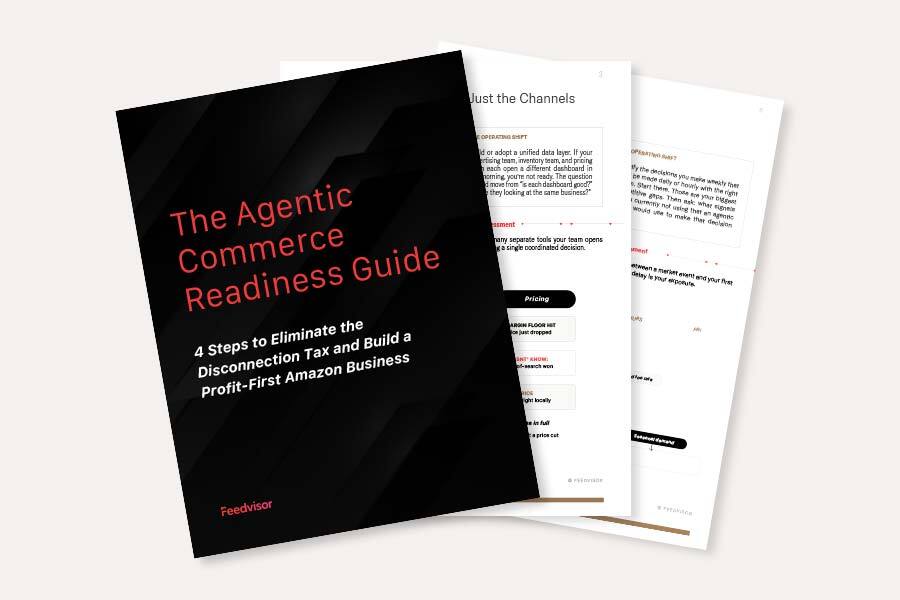
Why Agentic Commerce Won’t Fix Siloed Decision-Making
This article was originally published on Forbes on June 23, 2026
By Dani Nadel, President and COO

Dani Nadel
Dani is the President and Chief Operating Officer at Feedvisor. She is a recognized marketing and digital expert with more than 20 years of hands-on experience managing nationally recognized consumer and corporate brands.
We’re talking about agentic AI the wrong way.
The headlines focus on the consumer side: shopping agents that compare products, systems transacting on their behalf. Whether this fundamentally reshapes how consumers buy remains an open question.
But it’s only half the story. Another transformation is unfolding on the other side of the transaction: agents running the business, not serving the shopper. Less discussed, but already creating separation. Brands using these systems protect margin and capture demand others can’t see, while others watch efficiency metrics improve as economics decline.
For those brands, the symptom is a contradiction. Advertising spend is up (Amazon alone added $12 billion in incremental ad revenue in 2025). Pricing is competitive. Promotions are working. Margins are shrinking, enough that Marketplace Pulse calls it “The Great Compression.” The individual decisions are sound. The coordination between them isn’t.
This isn’t a data or a talent problem. It’s a structural failure in how decisions are made.
The Disconnection Tax
A brand is running a strong advertising program. Bids are competitive. Campaigns look healthy. Then a competitor drops price by 15%.
The ad platform doesn’t register the change. It keeps bidding into a now-uncompetitive product, watches conversion slip, and raises bids to compensate. The brand pays more to convert fewer customers.
Pricing can’t see rising acquisition costs. Inventory forecasts lag demand. Three systems. Three teams. One product. No shared awareness.
This is the disconnection tax. It doesn’t appear in any dashboard. It shows up in the gap between performance metrics and profit: compressed margin, inflated acquisition costs, accelerated stockouts.
Better Tools, Same Problem
The default response is predictable: upgrade the stack. Smarter bidding. Faster repricing.
It helps, incrementally. But it reinforces the underlying issue: each system improves at operating in isolation.
After more than a decade building these systems and over $50 billion in managed commerce, one pattern repeats. Optimizing each lever independently produces better metrics and worse outcomes.
Local optima do not sum to a global optimum. They never do.
Pricing affects conversion. Conversion affects ad efficiency. Budget allocation affects inventory velocity, which feeds back into margin. These are tightly coupled feedback loops, yet most systems behave as if they’re independent.
They aren’t just disconnected. They actively interfere with each other. Your ad engine responds to declining conversion without seeing pricing. Your pricing engine reads demand signals shaped by ad spend, mistaking paid demand for pricing power.
No dashboard shows this. The P&L does, after the fact.
What Agentic Commerce Actually Means
Agentic commerce is more than unified decision-making. These systems operate in continuous loops of reasoning and action, evaluating how variables interact and adapting decisions as conditions change.
Consider the same scenario in reverse. A competitor ends a promotion and returns to full price. Demand is stable. Inventory is deep. Reviews are strong.
A traditional ad platform might eventually notice. A pricing tool might eventually adjust. The delay costs margin. Each system sees only its slice. Multiply that blind spot across thousands of micro-decisions, and you see the structural cost disconnected systems have been hiding.
An agentic system sees the price change and simultaneously evaluates inventory, search trends, margin, and competitive positioning; raising bids to capture visibility while adjusting prices to expand margin. Both moves, informed by the same conditions, executed instantaneously.
No team coordinates that fast. No tool spans those decisions. No stitched-together stack connects them. But faster AI doesn’t get you here either. It makes siloed systems faster, not fundamentally different. Agentic systems weigh tradeoffs as a strategist would, in milliseconds, against the full state of the business.
What changes isn’t just speed; it’s what becomes visible. Tradeoffs previously split across three teams and surfaced months later in the P&L now appear in real time, before margin disappears.
The result: emergent coordination. Decisions align because they share context. The system coordinates itself.
From Channel Metrics to Economic Outcomes
This changes what gets optimized. Brands stop asking “What is our marketing efficiency?” and start asking “What is our contribution margin at this spend level?”
The difference isn’t semantic. Two brands can report the same marketing efficiency while one expands margin and the other compresses it. Strong returns can mask unprofitable growth when acquisition costs, pricing, and inventory are managed in silos.
When decisions are unified, ad spend stops being a standalone KPI. It becomes an input into profit, and the constraint shifts from budget efficiency to economic alignment.
That reframe exposes something uncomfortable. Many brands aren’t underperforming. They’re highly efficient at pursuing the wrong objective.
Once the objective changes, the advantage compounds. Every decision feeds back as a signal, calibrating the system to your category, pricing dynamics, and demand curves.
What This Means for Brands
Agentic systems don’t just improve performance. They expose structural gaps in how the business operates.
Most organizations are built around functional ownership: advertising, pricing, and inventory as separate disciplines, with no system responsible for how they interact. Every part is optimizing correctly. The system itself is getting worse.
Hero products, brand recognition, reviews, and organic ranking are compounding assets that take years to build and can erode invisibly when decisions are made in isolation. Closing that gap requires a different operating model:
- See the whole business, not the channels. Coordinated decisions require systems operating from the same view. Fragmented dashboards see only a slice.
- Break functional ownership. Assign accountability for how advertising, pricing, and inventory interact, not just how each performs alone. The decisions are coupled; the org structure should be too.
- Margin first. Set margin floors, then optimize spend against what those floors allow. Let margin lead the decisions, not channel metrics.
- Act with the market. Siloed models force a tradeoff: act fast on narrow data, or slowly on broader context. Agentic systems synthesize more signals and act, while the market is still moving.
The Real Constraint
Agentic AI is often framed as a future capability, but it’s already here in commerce.
McKinsey’s recent research on retail merchandising confirms: Early adopters are already seeing significant revenue and margin improvements, but most organizations lack the structure to scale it.
Look at your marketing dashboard. Then look at your P&L. If they tell different stories, the issue isn’t your team or your budget. Your systems were never designed to operate together.
Building agentic systems isn’t trivial. It requires domain-specific intelligence tuned to how categories move, guardrails against overconfident errors, and human oversight where decisions carry real risk. But the capability exists.
The remaining question: are you still optimizing in silos? Because siloed organizations don’t just underperform; they become economically incompatible with how the market now operates.
Press Contact
Marissa Incitti, Associate Director of Content
marissa.incitti@feedvisor.com