Categories
Latest Posts



Tags
Advertising Amazon Amazon Advertising Amazon Experts Amazon Listing Optimization Amazon Marketplace Amazon News Amazon Prime Amazon Professional Sellers Summit Amazon Seller amazon sellers Amazon Seller Tips Amazon Seller Tools ASIN Brand Management Brands Buy Box Campaign Manager Conference COVID-19 downloadable Dynamic Pricing Ecommerce FBA FBM Holiday Season industry news Multi-Channel Fulfillment Optimize pay-per-click Pricing Algorithm Pricing Software Private Label Profits Repricing Repricing Software Revenue Sales Seller Seller-Fulfilled Prime Seller Performance Metrics SEO SKU Sponsored Products Ads Strategy
Get the latest insights right in your inbox
Resource | Blog

- March 9, 2026
The Growth Paradox in E-Commerce
Brands are still growing, but rising retail media costs and marketplace economics are making that growth harder to monetize.
In many ways, 2025 looked like another strong year for digital commerce. Online sales continued to grow, retail media budgets expanded, and AI-powered tools gained traction across advertising and operations.
But beneath those headline numbers, the economics of growth began to change.
Many brands reported that monetizing demand became harder. Retail media costs continued to climb, performance became less predictable, and pressure on margins intensified. Growth didn’t disappear, but it became more difficult and more expensive to capture.
To understand how brands are adapting, Feedvisor surveyed more than 1,000 e-commerce brands for the 2026 Brand Survey. The findings point to an industry entering a new phase defined by accountability.
Cost pressure was nearly universal, with widespread reports of CPC inflation and rising operational expenses. As margins tightened, scrutiny over performance followed.
But the impact is not evenly distributed.
The data reveals a widening gap between brands that are successfully coordinating their commerce operations and those struggling with volatility. The difference isn’t simply how much brands spend. It’s how their operating model connects advertising, pricing, inventory, and measurement.
Retail media is no longer a peripheral growth lever. It now sits at the center of commercial performance.
Based on the survey results, three shifts are shaping the next phase of digital commerce:
- Retail media has entered an accountability era
- Measurement maturity has become a strategic advantage
- AI delivers measurable returns only where data foundations are robust
The findings below explore how brands are adjusting their strategies, from recalibrating channel mix to strengthening measurement frameworks and coordinating advertising with broader commerce operations.
Growth is still available. But in today’s environment, capturing it requires greater precision, discipline, and cross-functional coordination.

Dani Nadel
Dani is the President and Chief Operating Officer at Feedvisor. She is a recognized marketing and digital expert with more than 20 years of hands-on experience managing nationally recognized consumer and corporate brands.
Retail Media’s Accountability Era
Retail media keeps attracting investment, but its economics have changed. In our 2026 Brand Survey, nearly eight in ten brands reported year-over-year increases in cost-per-click, with roughly one-third experiencing increases above 10%. What was once incremental spend is now a fixed cost of competition, expected to justify its place in the P&L.
That shift marks retail media’s entry into its accountability era. At CES 2026, networks were openly compared to mature channels like search and social and held to the same standards: transparent measurement, clear incrementality, disciplined pricing.
U.S. retail media spend is projected to near $70 billion this year, propelled by upper-funnel off-site formats like CTV growing two to three times faster than on-site placements. In theory, more inventory creates opportunity. In practice, it increases fragmentation, bidding pressure, and performance variability, prompting CFOs to demand harder evidence before approving spend.
Retail media is no longer a growth hack at the edge of the budget. It’s a recurring cost of participation that must be actively engineered.
ADVERTISING SOLUTION
Superior Advertising Performance for Brands on Amazon and Walmart
Amazon: The Economics of Participation
Nowhere is that tension clearer than on Amazon. In our study, most brands rank it the top retail media network for ROI, and nearly half say it represents a substantial share of their e-commerce revenue. For most, it’s indispensable and increasingly expensive. Nearly half of surveyed brands reported double-digit CPC inflation on Amazon last year. Beyond media, most cited higher platform fees, fulfillment costs, and tariffs as material sources of margin pressure. Responses have been pragmatic: over half raised prices, more than one‑third reduced ad spend or adjusted assortment, and many diversified selling models to regain control and visibility.
Meanwhile, seller density keeps climbing, new ad formats proliferate, and automation reshapes the marketplace in real time. Amazon’s move toward unified, full‑funnel management, automated targeting, and agentic tools reduces friction but leaves little margin for error. Execution quality is now the main differentiator, hinging on tight coordination across pricing, promotions, and media decisions to protect unit economics. Amazon is the baseline for commerce participation; opting out forfeits demand; opting in without discipline forfeits profit.
The Counterbalance: Walmart
Walmart serves as the counterweight to that reality. Almost half of brands already advertise through Walmart Connect, with many expecting budget increases. That confidence is warranted: Walmart Connect’s 30%+ growth far outpaced its retail business.
Walmart’s appeal is both economic and strategic. It offers scale with a different cost profile, shopper mix, and competitive dynamic than Amazon. It’s also extending marketplace discovery through investments in AI-powered discovery and commerce integrations, including conversational shopping capabilities reported by Business Insider and CNBC. Together, Amazon and Walmart define the economic boundaries of retail media. Each is essential as an advertising engine and shared infrastructure anchoring digital commerce. But their performance is intertwined. Gains on one side create strain on the other, underscoring the need for coordinated management.
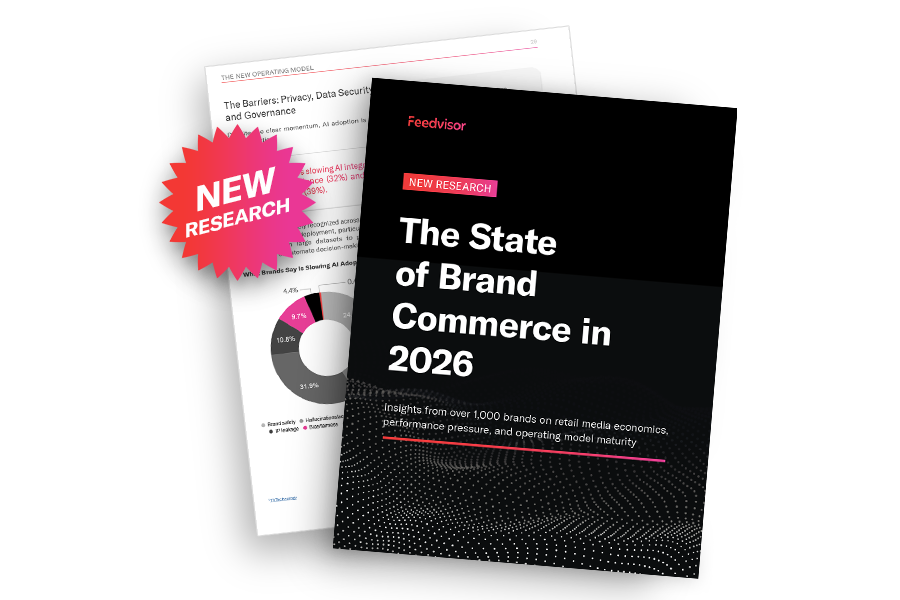
Download Your Copy of the 2026 State of Brand Commerce
The Funnel Rebalances, Measurement Becomes the Gate
Rising acquisition costs and compressed lower-funnel efficiency are forcing brands to rethink funnel strategy. A majority now invest in upper-funnel formats, from off‑site retail inventory to streaming video and CTV, to reach shoppers earlier and reduce dependence on expensive last-click tactics. But many risk overcorrecting, shifting budgets upstream before exhausting what remains controllable at point of conversion. In dense marketplaces, disciplined targeting, bid and budget management, and real-time optimization remain among the few levers left to protect unit economics.
Diversification follows a similar logic. New customer acquisition pushes brand spend beyond Amazon, with Walmart, Target, and TikTok leading those bets. Still, gravity remains with Amazon and Walmart, together expected to capture nearly 90% of incremental media investment. Measurement is the gatekeeper of that concentration. RoAS alone no longer unlocks budgets, pushing brands toward media mix modeling, incrementality techniques, and clean-room environments like Amazon Marketing Cloud. Even so, fragmented measurement limits investment for over half of brands.
AI Becomes Commerce’s Control Layer
The most forward‑looking story in the data isn’t any particular platform, but the role AI plays in linking them all. Eighty‑five percent of brands report using AI tools in marketing; and roughly half characterize them as co‑pilots under human oversight. That same infrastructure is rapidly reshaping discovery. Sixty-eight percent of brands expect AI assistants to have the greatest near-term impact on their business. Over half anticipate assistant-driven discovery will represent up to a quarter of product search traffic within a year.
As these experiences mature, most expect to pay for AI‑placed recommendations. AI no longer simply optimizes campaigns. It orchestrates commerce, determining which products surface, which bids win, and which messages align with predicted intent. In short, it allocates visibility. That carries risk and leverage alike. If pricing logic, margin guardrails, and assortment priorities aren’t encoded into the AI layer, systems will default to rewarding what’s cheapest or most aggressively funded, not what’s most strategic.
Designing for Harder Growth
Growth still exists, but the cost of accessing it is rising faster than the margin it yields. Retail media has matured, and its economics demand the same rigor applied to supply chain or pricing.
Sustainable growth won’t come from chasing shiny new channels. It will come from extracting more value from the infrastructure that already dominates: Amazon, Walmart, and the AI systems increasingly mediating buyer access. Together they form both the engine and constraint of digital growth, now earned through discipline and design, not simply bought with budget.