Categories
Latest Posts



Tags
Advertising Amazon Amazon Advertising Amazon Experts Amazon Listing Optimization Amazon Marketplace Amazon News Amazon Prime Amazon Professional Sellers Summit Amazon Seller amazon sellers Amazon Seller Tips Amazon Seller Tools ASIN Brand Management Brands Buy Box Campaign Manager Consumer Trends COVID-19 downloadable Dynamic Pricing Ecommerce FBA FBM Holiday Season industry news Multi-Channel Fulfillment Optimize pay-per-click Pricing Algorithm Pricing Software Private Label Profits Repricing Repricing Software Revenue Sales Seller Seller-Fulfilled Prime Seller Performance Metrics SEO SKU Sponsored Products Ads Strategy
Get the latest insights right in your inbox
Resource | Blog
- April 3, 2026
By: Marissa Incitti
Amazon Quietly Changed the Rules on Ad Payments. Most Brands Didn’t Notice.
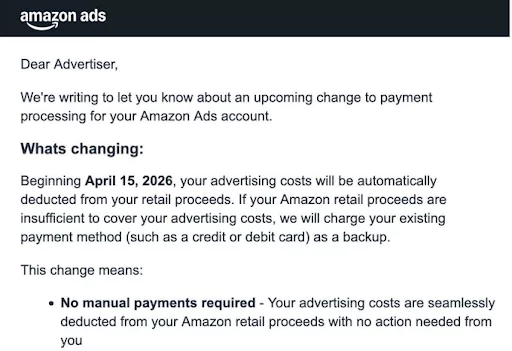
Amazon has started rolling out new rules tied to credit card usage, impacting profit margins starting as early as April 15th, and not every brand got the alert.
That alone should raise a red flag.
Because when Amazon introduces a change this impactful without broad communication, it’s usually not a test, but a directional shift. And we know how Amazon likes shifts.
On paper, this looks like a payment processing adjustment. An innocent response to rising transaction costs by offsetting fees associated with credit card usage.
In reality, it’s something much bigger. It’s Amazon inserting itself into how brands finance their business.

Marissa Incitti
What’s Actually Happening
For impacted brands, they will no longer be able to choose to use a credit card to pay for advertising fees, forcing them to be deducted from proceeds instead, starting April 15, 2026.
ADVERTISING SOLUTION
Superior Advertising Performance for Brands on Amazon and Walmart
But for many brands, credit cards are not just a payment method. They are a core part of the operating model. The points and perks from using a credit card can fund inventory purchases, bridge cash flow gaps, and often finance advertising spend during high-growth periods. And in some cases, they are the difference between scaling and stalling.
By limiting the profit of that mechanism, Amazon is effectively increasing the price of growth.
And it is doing so in a way that compounds across the business.
A brand that relies heavily on credit is now paying more to:
- Bring inventory into the system
- Compete for visibility through advertising
- Maintain operational liquidity during peak periods
This becomes bigger than a single fee, turning into a multiplier on existing cost pressures.
Download Your Copy of the 2026 State of Brand Commerce
The Emerging Reality: Cash Flow Is Now a Competitive Advantage
For years, performance on Amazon was driven by three primary levers: pricing, advertising execution, and inventory management.
Those levers still matter. But they are no longer sufficient.
Cash flow strategy is now part of the competitive equation.
Brands that rely heavily on credit cards to finance operations are now operating with a structural disadvantage. Their cost of capital has increased, which directly impacts how aggressively they can invest in inventory and advertising.
Brands with stronger balance sheets (or more disciplined financial strategies) are better positioned to absorb these changes and continue scaling efficiently.
This aligns with broader payment and commerce trends. Data from strategists and experts shows that merchants are increasingly rethinking liquidity and funding strategies as payment-related costs rise and margins tighten across digital commerce.
Amazon is accelerating that shift within its own ecosystem.
The Silent Rollout Is the Strategy
Not every brand received a notification. That is consistent with how Amazon typically operates.
Historically, Amazon has introduced major changes, whether related to fees, Buy Box dynamics, or advertising mechanics, through phased rollouts. It tests impact within specific cohorts, measures behavior, and then expands.
This allows Amazon to refine the model before it becomes universal.
It also means that by the time a change is widely recognized, the competitive landscape has already shifted.
If you have not been directly impacted yet, that should not be interpreted as immunity, but as timing.
Advertising Costs Follow a Similar Pattern
If this dynamic feels familiar, it should.
Advertising on Amazon has evolved in a similar way.
Costs have increased steadily, not just because more brands are competing, but because Amazon is continuously optimizing for revenue per interaction. Every search result, every placement, every impression is an opportunity to extract value.
According to eMarketer, retail media is among the fastest-growing and most profitable segments in digital advertising. That profitability incentivizes platforms like Amazon to expand ad inventory, introduce new placements, and increase competition.
The result is a system where costs rise not randomly, but predictably.
Payments are now entering that same optimization loop.
What This Means for How Brands Operate
These changes cannot be addressed with incremental adjustments. They require a shift in how brands think about performance.
First, profitability must replace efficiency as the primary lens. Metrics like ROAS or ACOS are no longer sufficient on their own, because they do not account for the full cost structure that now includes payment-related fees, rising ad costs, and fulfillment expenses. Brands need to understand contribution margin at a granular level, across products and campaigns.
Second, advertising can no longer operate independently from other business signals. Campaign performance is directly influenced by pricing competitiveness, inventory availability, and Buy Box ownership. When these elements are misaligned, rising costs amplify inefficiencies. When they are aligned, they create compounding returns.
Third, operational decisions need to be made within a connected system. This is where platforms like Feedvisor become critical, because they enable brands to unify pricing, advertising, and demand signals into a single decision-making framework. In a managed ecosystem, isolated optimization is not enough.
The Direction Is Clear
Amazon is extending its influence beyond the point of sale.
It is shaping:
- How demand is generated (through advertising)
- How conversion happens (through pricing and fulfillment dynamics)
- How businesses are funded (through payment-related cost structures)
Each of these layers reinforces the others.
Each of these layers increases Amazon’s control over the system.
And each of these layers introduces new pressure on brand margins.
Final Thought: This Is How Amazon Evolves the Marketplace
It would be easy to dismiss this as another operational change on Amazon, only impacting a few. It is not.
It is a continuation of a long-standing pattern where Amazon refines its ecosystem to maximize efficiency, protect the customer experience, and expand its own margin opportunities.
This shift in how advertising is paid, prioritizing earning sover credit, is simply the latest expression of that pattern.
Because on Amazon, the rules rarely change overnight. They evolve quietly until suddenly, they are the new standard.
FAQs
- What is Amazon’s new policy on using credit cards for advertising fees?
Amazon is changing how advertising fees are paid by prioritizing deductions from a seller’s available balance (earnings) first. Credit cards can still be used, but only as a secondary payment method when there are insufficient funds in the account. This effectively removes credit cards as the default way to fund advertising spend. - Is Amazon charging new credit card fees for advertising?
No, Amazon is not introducing a direct fee for using credit cards. Instead, it is restructuring the payment hierarchy—requiring brands to use their earnings balance first before turning to credit. While subtle, this change impacts how brands manage liquidity and cash flow. - Why is Amazon making this change to advertising payments?
At a surface level, this reduces Amazon’s exposure to payment processing costs and credit risk. At a deeper level, it reinforces Amazon’s broader model: keeping the customer experience intact while shifting financial and operational pressure upstream to sellers. By prioritizing earnings over credit, Amazon is encouraging more disciplined, self-funded growth. - How does this change impact cash flow and advertising strategy?
This change tightens the connection between revenue and reinvestment. Brands that previously relied on credit to aggressively fund advertising may now face constraints if their available balance is low. As a result, advertising budgets may become more directly tied to sales performance, limiting flexibility but increasing pressure on efficiency and profitability. - What should brands do to adapt to this change?
Brands should reassess how they fund advertising and manage working capital. This includes improving forecasting, aligning ad spend more closely with inventory and pricing, and ensuring profitability at the SKU level. Solutions like Feedvisor help connect these signals, allowing brands to make smarter, more responsive decisions in a more constrained cash flow environment.