Categories
Latest Posts



Tags
Advertising Amazon Amazon Advertising Amazon Experts Amazon Listing Optimization Amazon Marketplace Amazon News Amazon Prime Amazon Professional Sellers Summit Amazon Seller amazon sellers Amazon Seller Tips Amazon Seller Tools ASIN Brand Management Brands Buy Box Campaign Manager Consumer Trends COVID-19 downloadable Dynamic Pricing Ecommerce FBA FBM Holiday Season industry news Multi-Channel Fulfillment Optimize pay-per-click Pricing Algorithm Pricing Software Private Label Profits Repricing Repricing Software Revenue Sales Seller Seller-Fulfilled Prime Seller Performance Metrics SEO SKU Sponsored Products Ads Strategy
Get the latest insights right in your inbox
Resource | Blog
The Future of Amazon Advertising Isn’t Winning the Click. It’s Earning the Recommendation.
- June 8, 2026
- By: Dani Nadel, President and COO
For more than two decades, Amazon advertising has operated under a relatively simple premise: help shoppers find products and influence which products they click. The model worked. Retail media budgets exploded, and Amazon alone added more than $12 billion in incremental ad revenue in 2025.
With the growth, the mechanics evolved. Keywords became more sophisticated. Automation became more intelligent. But the underlying model remained remarkably consistent: a shopper searched, Amazon returned a page of results, and the shopper decided what to buy.
That model is now changing.
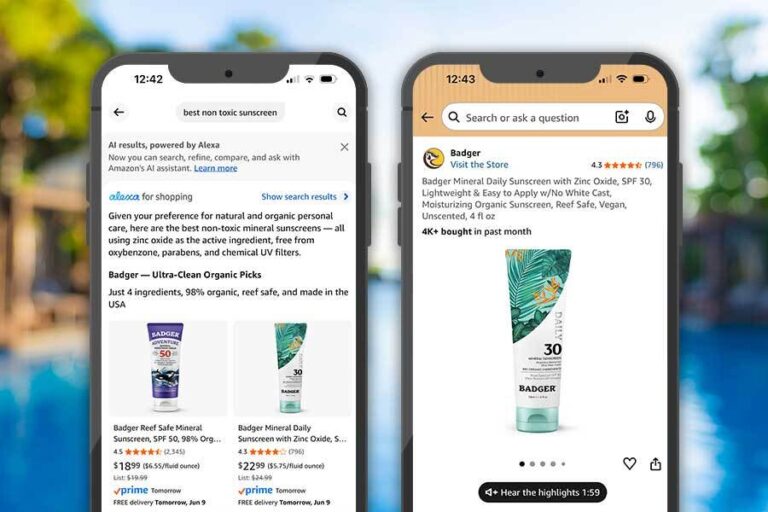
Research from Workflow Labs found that AI-assisted discovery through Rufus effectively compressed product consideration from roughly fifty products on a traditional search results page to approximately five recommended products surfaced through conversational interactions. That’s a 90% reduction in visibility for the average product. As of May 2026, Amazon’s new Alexa for Shopping experience has moved those AI-powered interactions directly into the primary search experience for all U.S. shoppers.
For years, brands competed for visibility. Increasingly, they are competing for recommendation. That may sound like semantics, but it really isn’t.
Visibility means a shopper sees your product and makes a decision. Recommendation means an AI assistant makes the first decision before the shopper ever sees your product. The decision-maker at the top of the funnel has changed. And that changes everything about how brands should think about advertising.

Dani Nadel
Dani is the President and Chief Operating Officer at Feedvisor. She is a recognized marketing and digital expert with more than 20 years of hands-on experience managing nationally recognized consumer and corporate brands.
The Signals Are Already There
The strongest evidence that Amazon sees AI-assisted commerce as a strategic priority is not Alexa itself. It’s the infrastructure Amazon has built around it.
Consider what happened on March 25. Sponsored Prompts moved from beta to a billable placement model, automatically enrolling existing campaigns into AI-powered conversational advertising experiences. Many brands are already paying to participate in recommendation-driven shopping journeys, whether they realize it or not.
We’ve already observed shifts in how advertising spend translates to discovery within AI-mediated sessions. Early data suggests conversion rates from recommendation-driven shopping journeys differ meaningfully from traditional keyword-search sessions, both in magnitude and in what drives them.
At the same time, Amazon has consolidated its advertising infrastructure through a unified Campaign Manager, bringing Sponsored Ads and DSP management closer together. The company is also actively protecting its discovery ecosystem, reportedly blocking dozens of external AI bots from scraping Amazon’s marketplace data.
Taken together, these moves point in the same direction. Amazon is not treating AI as an add-on feature, it is rebuilding discovery, advertising, and commerce around AI-mediated decision-making.
There’s no longer a question that AI will influence shopping behavior. The question is how quickly it becomes the primary mechanism through which shoppers discover products.
Amazon Advertising Has Entered the Recommendation Era
Much of the discussion surrounding Alexa for Shopping has focused on listing optimization.
The advice is familiar: improve bullet points, expand product attributes, strengthen Q&A content, and ensure your listings are AI-readable.
All of that is important but none of it is sufficient.
The reality is that Alexa is not evaluating products the same way a search engine evaluates keywords.
When a shopper asks: “What is the best protein powder for runners under $40?” the assistant is not simply matching words. It is evaluating products across a broad set of signals, including:
- Product content and attributes
- Customer reviews and sentiment
- Price competitiveness
- Inventory availability
- Historical conversion performance
- Brand credibility
- Shopping context and intent
This is a different decision framework than traditional search. In the search era, visibility could often be purchased. In the recommendation era, visibility must increasingly be earned.
The New Visibility Equation
Historically, many Amazon advertising strategies could be simplified to a relatively straightforward formula:
Keyword Relevance + Bid Strength = Visibility
Brands invested heavily in identifying the right keywords, building campaign structures around them, and optimizing bids to secure placement.
That approach remains important. But AI-mediated discovery introduces an entirely new equation. Today, recommendation decisions increasingly depend on: Customer Intent + Product Relevance + Commercial Performance
Notice what disappears from the equation. The AI is not asking which brand spent the most. It is asking which product it is most confident recommending.
Confidence comes from signals. Lots of them. And many of those signals live outside the advertising console.
Why Advertising Teams Suddenly Need to Care About Pricing, Inventory, and Reviews
This is where many brands will struggle. Most organizations still manage advertising, pricing, inventory, content, and operations as separate functions with separate goals and separate systems.
Advertising teams optimize ROAS. Pricing teams manage margins. Operations teams focus on inventory. Content teams improve listings.
Historically, those silos were inefficient but manageable. Alexa changes that.
The assistant does not evaluate these functions separately. It evaluates them simultaneously.
The recommendation engine evaluates the complete commercial context surrounding a product, pricing, inventory, content, reviews, and advertising performance together, even when organizations manage them separately. Visibility is increasingly determined by the strength of that full signal profile, not just bids, keywords, and campaign structure alone.
- A product experiencing inventory instability becomes less attractive to recommend.
- A product with weak review sentiment becomes less attractive to recommend.
- A product priced significantly above competitive alternatives becomes less attractive to recommend.
- A product generating high click volume but weak conversion performance becomes less attractive to recommend.
We’ve already seen examples where products maintained strong keyword rankings and healthy advertising performance yet lost visibility within AI-generated recommendations because their pricing became uncompetitive relative to comparable alternatives. The AI wasn’t evaluating the campaign. It was evaluating the entire competitive context.
In other words, advertising performance can no longer be separated from overall commerce performance. The signals are connected, whether the organization managing them is connected or not.
This is where many brands will encounter what I have previously called the disconnection tax: the hidden cost of managing interconnected signals through disconnected systems. In an AI-mediated discovery environment, that cost compounds because the assistant evaluates those signals together, even when the organization does not.
Three Strategic Shifts Brands Need to Make
The brands adapting fastest to AI-driven discovery are already shifting their thinking.
Shift #1: From Keywords to Intent
Keywords remain important but they are increasingly becoming inputs rather than outcomes.
Consumers are asking more sophisticated questions. They are describing needs, situations, constraints, and desired outcomes. When a shopper asks Alexa ‘what’s a good gift for a runner who hates carrying water bottles,’ no keyword strategy covers that query. But a hydration vest with strong reviews mentioning ‘gift’ and ‘running’ has a chance of being recommended. Understanding how products fit into real shopping contexts, not just keyword taxonomies, will result in disproportionate share in conversational discovery.
Shift #2: From Campaign Optimization to Signal Optimization
Traditional advertising focused on optimizing campaigns. The recommendation era requires optimizing the entire product signal profile.
Every review, every pricing decision, every inventory event, every content update, and every advertising interaction contributes to how confidently an AI can recommend a product.
The campaign is no longer the unit of optimization. The product is.
That’s a meaningful change for organizations that have built entire teams, tools, and reporting structures around campaign performance. When the AI evaluates the product holistically, a strong campaign attached to a weak signal profile loses to a weaker campaign attached to a strong one.
Shift #3: From Managing Ads to Managing Outcomes
The most important shift is organizational.
Brands can no longer afford to manage advertising, pricing, inventory, and content as independent activities. Those signals influence one another.
More importantly, AI systems evaluate them together. The brands that connect their advertising, pricing, and inventory signals into a single decision-making layer, whether through technology, organizational design, or both, will outperform brands that coordinate those decisions through Slack threads and weekly meetings. The speed mismatch alone will create separation.
The Operational Challenge
The compression of discovery from fifty products to five is unlikely to reverse. Rufus reportedly influenced 38% of Amazon shopping sessions during Black Friday 2025, and Alexa for Shopping is now available to every U.S. shopper. The trajectory is clear.
Amazon is investing heavily in AI-powered shopping experiences, and recommendation-driven discovery is becoming an increasingly important part of the customer journey.
The implication for brands is profound. AI assistants are becoming a permanent layer between shoppers and products.
And they don’t evaluate the way organizations operate. They evaluate the way products compete.
Recommendation systems assess pricing, content, inventory, reviews, competitive positioning, and advertising performance together. Most brands still manage those functions separately.
As recommendation-driven discovery expands, advertising can no longer be viewed as a standalone function. Visibility increasingly depends on the combined strength of the entire product signal profile.
That gap is where visibility will be won or lost.
The brands building their recommendation profile now, across advertising, pricing, content, inventory, and reviews, will compound that advantage through every Prime Day, Back-to-School season, and holiday event ahead.
Those still optimizing for clicks alone may find their rankings unchanged and their traffic declining. Because in the recommendation era, the question is no longer whether shoppers can find your product. It’s whether the AI chooses to recommend it.