Categories
Latest Posts

Tags
Advertising Amazon Amazon Advertising Amazon Experts Amazon Listing Optimization Amazon Marketplace Amazon News Amazon Prime Amazon Professional Sellers Summit Amazon Seller amazon sellers Amazon Seller Tips Amazon Seller Tools ASIN Brand Management Brands Buy Box Campaign Manager Consumer Trends COVID-19 downloadable Dynamic Pricing Ecommerce FBA FBM Holiday Season industry news Multi-Channel Fulfillment Optimize pay-per-click Pricing Algorithm Pricing Software Private Label Profits Repricing Repricing Software Revenue Sales Seller Seller-Fulfilled Prime Seller Performance Metrics SEO SKU Sponsored Products Ads Strategy
Get the latest insights right in your inbox
Resource | Blog
Amazon Ads | This blog is part of our Amazon Ad series where we dive deep into each ad type.
How to Optimize Amazon Sponsored Products Ads in 2026
- April 23, 2026
- By: Dani Nadel, President and COO

Dani Nadel
Dani is the President and Chief Operating Officer at Feedvisor. She is a recognized marketing and digital expert with more than 20 years of hands-on experience managing nationally recognized consumer and corporate brands.
TL;DR: Amazon Sponsored Brands optimization in 2026 is no longer about headline testing and bid adjustments. It is a system-level discipline that integrates creative strategy, Brand Store investment, new-to-brand measurement, and full-funnel coordination with Sponsored Products, Sponsored Display, and DSP. This guide outlines the 10-step framework that high-growth brands and vendors are using to scale brand awareness and consideration profitably on Amazon.
Who This Guide is For: Brand managers, marketing directors, and executives at mid-to-large brands selling on Amazon as third-party sellers (3P) or first-party vendors (1P) who need to scale Sponsored Brands profitably while building sustainable brand equity in an increasingly competitive environment. This guide builds on the Sponsored Products optimization framework outlined in Part 1 of this series, extending the system-level approach to Amazon’s primary brand-building ad format.
What Are Amazon Sponsored Brands?
Amazon Sponsored Brands is an Amazon advertising format that appears across premium search placements, helping brands control messaging, product curation, and shopper navigation across the discovery journey.
Unlike Sponsored Products, which captures demand at the individual product level, Sponsored Brands builds brand awareness, drives consideration, and expands share of voice at the category level. It is Amazon’s primary on-site upper-funnel and mid-funnel advertising format, driving shoppers to a Brand Store or product listing page rather than a single product detail page.
Sponsored Brands operates across three distinct formats, each serving a different strategic objective:
- Product Collection displays a brand logo, custom headline, and a selectable product pool from which Amazon dynamically features the most relevant products based on shopper intent and search signals. It can link to a Brand Store or a custom landing page and is the most versatile SB format for driving both discovery and conversion.
- Store Spotlight showcases up to three Brand Store sub-pages with custom images and labels, driving traffic directly into the Brand Store experience. It is best suited for brands with a deep catalog and a well-developed Brand Store.
- Sponsored Brands Video is an auto-playing video ad that appears within search results, and can direct traffic either to a single product detail page or to a Brand Store featuring selected products.
What makes Sponsored Brands strategically distinct is that it operates across four demand layers simultaneously:
- Demand Capture (Branded Search Defense): Protecting high-intent branded queries, preventing competitor conquesting, and anchoring brand presence at the top of search results.
- Demand Shaping (Category and Generic Search): Influencing consideration at category entry, positioning the brand as a default option.
- Demand Expansion (New-to-Brand Growth): Introducing product portfolios to new audiences, leveraging Brand Store for deeper engagement, and supporting cross-sell pathways.
- Demand Redirection (Competitor Conquest): Capturing traffic from competitor keywords and shifting consideration before product-level evaluation begins.
Importantly, these layers also support cross-sell and upsell pathways across the broader product portfolio.
Sponsored Brands is the only Amazon advertising format that simultaneously controls messaging, product grouping, and navigation flow across all four layers. That is what makes it a strategic asset rather than a tactical placement.
Why Sponsored Brands Matter More in 2026
In 2026, Sponsored Brands is no longer a top-of-funnel awareness lever. Treating it that way is one of the fastest ways to underperform in 2026. It is a control layer for how demand is created, shaped, and directed across Amazon.
At its core, Sponsored Brands is a demand pathway system. It determines not just whether a shopper clicks, but where they go, what they see next, and how they evaluate your brand versus competitors.
As search becomes more AI-mediated, visual, and brand-forward, Sponsored Brands increasingly determines which brands win visibility at the moments that shape consideration (which brands dominate branded queries, which products anchor category discovery, how shoppers transition from search to consideration, whether competitors intercept high-intent traffic)
At the same time, rising CPCs are increasing the cost of demand capture. According to the Feedvisor 2026 Benchmark Report, nearly eight in ten brands report rising CPCs, with nearly half seeing double-digit inflation. As Sponsored Products become more expensive, the efficiency of upper-funnel investment becomes critical. Sponsored Brands feeds Sponsored Products performance, building the recognition and consideration that makes demand capture more efficient downstream. Treating them in isolation remains one of the most common and costly structural mistakes in Amazon advertising.
Two additional forces are accelerating this shift. First, new-to-brand acquisition has become a primary executive priority. Leadership teams increasingly expect advertising to expand the customer base, not just recapture existing demand. Sponsored Brands provides direct visibility into this through new-to-brand metrics. Second, branded search defense is no longer optional. Without Sponsored Brand coverage, competitors can intercept high-intent traffic on your own branded terms at the point of search.
Looking ahead, the structural importance of Sponsored Brands will only increase. As Amazon integrates more AI into search and discovery, brand-led placements will expand, Brand Store experiences will become more critical to conversion, and Sponsored Brands will function not just as an ad format but as a brand authority signal within AI-driven discovery.
The Feedvisor 2026 Sponsored Brands Optimization Model
Step 1: Anchor Sponsored Brands to Brand Growth Objectives, Not ROAS Alone
Sponsored Brands serves fundamentally different objectives than Sponsored Products, and measuring it with the same benchmarks leads to chronic underinvestment. Sponsored Brands’ primary role is brand awareness, consideration, new-to-brand acquisition, and category share of voice. Applying Sponsored Products’ ROAS or ACOS benchmarks to SB systematically undervalues its contribution and misdirects budget.
The right measurement framework for Sponsored Brands includes:
- New-to-brand order percentage, the share of SB-attributed orders from first-time brand buyers
- Branded search volume lift, an indicator of whether SB investment is building brand recognition
- Brand Store engagement metrics including visits, dwell time, and pages per visit
- Impression share on category and branded terms
- Blended TACOS across the full advertising portfolio
The right question is not “what is Sponsored Brands’ ROAS?” It is “what happens to total demand system performance when SB investment increases or decreases?” Brands that have tested this rigorously consistently find that SB’s contribution is significantly larger than last-click attribution suggests.
Establish SB-specific KPIs tied to upper-funnel and mid-funnel goals before campaigns launch, not after the first month of data. Without the right measurement framework in place, Sponsored Brands will always look underperforming relative to Sponsored Products, and budget will consistently flow to the wrong format.
1P Vendor Note: Vendors should pay particular attention to new-to-brand metrics as a justification for Sponsored Brands investment. Amazon’s reporting provides NTB data that can be tied directly to vendor growth objectives and annual vendor negotiations, making it a powerful tool for defending and growing the Sponsored Brands budget internally.
Step 2: Invest in Video Creative as the Primary Growth Lever
Sponsored Brands Video is the highest-engagement Sponsored Brand format and should represent an increasing share of SB budget in 2026. In most categories, video drives materially higher click-through rates than static Product Collection ads, and the gap is widening as shopper behavior on Amazon continues to mirror broader e-commerce trends toward video-first discovery.
Creative best practices for Sponsored Brands Video are specific and unforgiving.
- Lead with the core product benefit in the first two to three seconds. Most shoppers will not watch beyond this threshold, and an opening that fails to communicate value immediately will underperform regardless of production quality.
- Combine lifestyle context with clear product demonstration.
- Design for mobile viewing with vertical aspect ratios and large text overlays.
- Do not depend on audio. The majority of Amazon shoppers browse with sound off, and a video that requires audio to communicate its message is structurally compromised.
- Keep videos between 15 and 30 seconds. Shorter outperforms longer in most categories. Creative performance must be tested and optimized continuously, not set once.
Creative fatigue sets in faster with video than static formats, which means monthly creative rotation is a baseline requirement, not an advanced tactic.
A structured video testing program should isolate variables individually: messaging angles (eg, problem/solution vs. feature-led), product focus versus lifestyle, and different hero products. Testing multiple variables simultaneously produces unreadable results.
While SB reporting does not currently support granular device- or daypart-level optimization natively, sophisticated advertisers use AMC and portfolio-level analysis to inform creative strategy, budget allocation, and cross-format coordination.
Brands still concentrating Sponsored Brands investment in static Product Collection while competitors scale video are ceding a meaningful engagement advantage. At scale, managing video performance requires automated creative rotation and fatigue detection. High-performing programs increasingly use AI systems to identify declining engagement early and trigger creative refreshes before performance degrades.
Step 3: Build Brand Store as a Conversion Destination
Amazon Brand Store is a free, multi-page, customizable storefront available to brand-registered sellers and vendors. It is the only destination on Amazon where a brand controls the full shopping experience without competitor ads.
That distinction matters enormously. Every click driven to a product detail page reintroduces competition because sponsored placements give other brands a direct opportunity to intercept the shopper. Every click driven to the Brand Store places the shopper in a controlled brand environment.
Sponsored Brands ads should increasingly drive traffic to the Brand Store rather than individual product pages. This increases average basket size, enables cross-selling, and eliminates the competitor ad exposure that product page destinations create.
Brand Store optimization priorities:
- Map each campaign to a specific store page or product set aligned to the campaign’s intent, not a generic landing page.
- Organize pages by use case, product line, or shopper need rather than by internal catalog structure.
- Use lifestyle imagery that reinforces brand positioning rather than product-only layouts.
- Integrate shoppable content modules and video where available.
- Update the store monthly, particularly around promotional windows and seasonal peaks. Stores that update regularly see significantly higher repeat visit rates and stronger performance from Store Spotlight campaigns.
Track Brand Store Insights rigorously: visits, attributed sales, dwell time, page-level performance, and traffic source breakdown. These metrics reveal which SB campaigns are driving the highest-quality store traffic and which store pages are converting that traffic most effectively.
Brand Store quality directly impacts Sponsored Brands ad performance. It also functions as both a controlled conversion environment and a signal engine, generating behavioral data that can be used to refine creative strategy, targeting, and downstream DSP activation.
Step 4: Segment Campaigns by Format and Intent
The same segmentation discipline from Part 1 applies to Sponsored Brands with one critical addition: format separation must come first.
Separate by Format
Product Collection, Store Spotlight, and Video must run in distinct campaigns. Each has different performance profiles, creative variables, and optimization levers. Blending them obscures signals and prevents meaningful creative testing. Most programs reverse this sequencing and lose signal clarity immediately.
One caveat: segmentation only creates value when campaigns have sufficient budget and volume to generate meaningful data. Over-segmentation without scale fragments signals and suppresses performance.
Segment by Intent
Within each format, segment by intent layer:
- Branded terms: Defend high-intent brand queries and maintain impression dominance
- Category and generic terms: Drive discovery and new-to-brand acquisition
- Competitor terms: Conquest demand with differentiated messaging and higher ACoS tolerance
- Exploratory terms: Capture long-tail queries where intent is forming and early brand exposure shapes downstream consideration
Apply Match Type Discipline
- Broad match only in dedicated discovery campaigns with strict negatives — it burns budget quickly, particularly in Video where CPC is already elevated
- Phrase match for controlled expansion
- Exact match for high-value proven queries — note that exact match isolation in SB is more complex than SP because headline, featured ASINs, and landing destination add creative variables that SP doesn’t have
Control Placement Bid Modifiers
Top of search is disproportionately valuable for Sponsored Brands. The banner placement is where brand-level creative has the most visual impact. Apply aggressive top-of-search multipliers on high-priority terms while reducing product page bids unless actively conquesting. Video and Product Collection have different optimal placement profiles — Video performs strongest at top of search, while Product Collection can perform efficiently across a broader range of placements. Manage them with separate bid modifier strategies.
Use Negative Keywords to Prevent Internal Competition
Cross-negation between Sponsored Brands and Sponsored Products is one of the most underleveraged efficiency levers at scale. Let Sponsored Products capture high-intent exact-match demand. Let Sponsored Brands own upper-funnel and brand-led queries. Without this discipline, the two formats cannibalize each other.
Structure Competitor Conquesting Separately
Target competitor terms at phrase and exact match, not broad. Set ACoS thresholds that reflect the structurally lower conversion rate of competitor traffic. Lead with products that create a compelling competitive contrast: differentiation, stronger reviews, pricing advantage, or value positioning.
Align Budget to Objective
If new-to-brand acquisition is the priority, weight toward generic category campaigns. If brand defense is the priority, weight toward branded terms. A single blended campaign cannot optimize for both.
Step 5: Optimize Headline Copy and Creative Assets
The headline is the primary differentiator in Sponsored Brands placements. It is the first text a shopper reads and the main driver of click-through rate. Yet it remains one of the most underleveraged optimization levers in most Sponsored Brands programs. Most brands set a headline at launch and rarely revisit it.
Benefit-led, keyword-aligned headlines consistently outperform generic brand-led messaging. “Clinically Proven Joint Support — Shop Now” will typically outperform generic brand-led messaging like “Welcome to [Brand Name]” every time because it communicates immediate shopper value rather than brand presence alone. Test different value propositions systematically: price and value, quality and efficacy, selection and variety, social proof and awards. What resonates varies by category and competitive context, and the only way to know is to test.
For Product Collection campaigns, the three featured ASINs matter as much as the headline. Lead with bestsellers or highest-rated products. Featuring new or underperforming SKUs in primary Sponsored Brands creative positions undermines even a strong headline.
Strong visual hierarchy and contextual product presentation consistently outperform generic product groupings, particularly in categories where aspiration, lifestyle fit, or use context influence purchase behavior and conversion.
Establish a testing cadence and hold to it. Rotate headlines monthly. Test new custom images quarterly. Refresh video creative monthly. Treat creative optimization as an ongoing program, not a one-time setup task.
Step 6: Prioritize New-to-Brand Metrics
A new-to-brand order is a purchase made by a shopper who has not bought from your brand on Amazon in the past 12 months. New-to-brand percentage (NTB%) measures the share of ad-attributed orders that come from these first-time brand buyers. It is the most direct indicator of whether Sponsored Brands is expanding the customer base or recapturing existing demand.
NTB% is the metric that justifies Sponsored Brands investment to leadership teams who want proof that advertising is growing the business, not just sustaining it. Without it, SB will always lose the budget conversation to Sponsored Products, which shows stronger direct ROAS but tells you nothing about customer acquisition.
How to use NTB data to inform strategy:
Generic and category Sponsored Brands campaigns typically show higher NTB%, often 60 to 80 percent or above in competitive categories. This is expected and valuable. These campaigns are reaching shoppers who have never purchased from your brand, and the higher cost per acquisition is justified by the lifetime value those customers represent.
Branded SB campaigns show lower NTB% by design. Their role is defensive, protecting existing brand equity and preventing competitor interception. Low NTB% on branded campaigns is not a problem. It is confirmation the campaign is doing its job.
The signal to watch is directional change. Rising NTB% on generic campaigns means your upper-funnel investment is working, you are reaching new audiences effectively. Declining NTB% on generic campaigns signals one of three things: audience saturation (the same shoppers are seeing your ads repeatedly without converting), creative fatigue (the messaging has lost its impact), or reduced incrementality (organic demand is growing and SB is increasingly capturing shoppers who would have found you anyway).
Connect NTB to lifetime value where possible. A first-time buyer acquired through Sponsored Brands who repurchases twice over the next 12 months is worth far more than the initial ROAS suggests. Brands that can tie NTB acquisition to 6- or 12-month repurchase rates can model the true ROI of SB investment, and consistently find that SB’s contribution is larger than first-click metrics indicate.
Use NTB% as a budget allocation input, not just a reporting metric. If a generic category campaign is delivering 75% NTB orders at a manageable ACoS, that campaign deserves more budget — even if its direct ROAS is lower than a branded campaign. The branded campaign is protecting existing demand. The generic campaign is creating new demand. Both are valuable, but only one is growing the customer base.
1P Vendor Note: NTB data is particularly powerful for vendors in annual negotiations with Amazon. Demonstrating that Sponsored Brands investment is driving measurable new-to-brand acquisition, not just recapturing existing demand, strengthens the case for maintaining or increasing advertising investment and can support broader vendor growth objectives.
Step 7: Coordinate Sponsored Brands With Sponsored Products, Sponsored Display, and DSP
Sponsored Brands and Sponsored Products serve complementary roles in the Amazon demand system. Sponsored Brands shape consideration across premium search placements, including top-of-search banners, in-line video within search results, and lower-search positions. Sponsored Products captures purchase intent and closes the sale at the product level. Neither performs optimally in isolation.
The brand recognition and category presence built through Sponsored Brand makes Sponsored Products more efficient downstream. Shoppers who have already encountered your brand through Sponsored Brand convert at higher rates when they later see your Sponsored Products ads. Protect branded search with both formats simultaneously: Sponsored Brands controls brand messaging across multiple search placements while Sponsored Products captures in-grid product-level visibility. Without both, competitors can insert themselves into your branded search results at multiple points.
Sponsored Display and DSP extend this system further, driving retargeting and audience-based engagement across Amazon and off-Amazon environments, reinforcing consideration throughout the funnel and re-engage shoppers who haven’t yet converted.
DSP audience insights should also inform Sponsored Brands strategy, particularly around creative themes, landing destinations, and funnel coordination. While SB does not support the same level of audience-level sequencing available in DSP, high-performing programs align SB creative and Brand Store experiences to broader demand signals surfaced across the portfolio.
Do not evaluate Sponsored Brands and Sponsored Products in isolation. If reducing Sponsored Brands investment causes Sponsored Products efficiency to decline, and it frequently does, then the blended system is less profitable without Sponsored Brands even if Sponsored Brands’s direct ROAS appears lower. Amazon Marketing Cloud (AMC) path-to-purchase analysis and overlap reporting provide the visibility needed to evaluate SB’s true contribution beyond last-click attribution.
1P Vendor Note: Vendors should coordinate SB investment with Sponsored Products and DSP strategies within a unified reporting framework. AMC audience insights can inform broader audience strategy, DSP activation, measurement, and cross-format optimization decisions.
Step 8: Align SB Strategy With Pricing, Inventory, and Promotional Calendar
The same foundational principle established in Part 1 applies here: advertising amplifies commercial strength. It does not compensate for commercial weakness. Sponsored Brands is no exception. Increase SB investment during major product launches selectively, particularly when supporting hero SKUs, established product lines, or launches with strong review, pricing, and inventory readiness.
Coordinate SB headline copy with active Deals, Coupons, or Lightning Deals. A headline that references an active promotion drives materially higher click-through rates than a generic brand message. During seasonal peaks and major retail events, SB spend should increase in line with demand, and headline messaging should reflect the promotional context.
Throttle SB spend when inventory is constrained across the featured ASINs. Driving traffic to out-of-stock products wastes spend, damages the Brand Store experience, and undermines the brand impression SB is designed to create. Similarly, running SB aggressively when featured products are priced uncompetitively sends traffic to listings that will convert poorly, inflating cost without generating proportionate return.
SB headline and creative messaging should be updated to reflect the current promotional calendar. Running a generic headline during a major sale event is a significant missed opportunity. At scale, this promotional alignment must be systematized rather than managed reactively, connecting advertising creative and budgets to the promotional and inventory calendar automatically rather than through manual coordination.
Step 9: Monitor Competitive Share of Voice
The top-of-search banner is the most visible placement on Amazon search results pages. If your brand is not occupying it on your category and branded terms, a competitor is. This is not a theoretical concern. It is a daily competitive reality of Amazon’s search environment in 2026.
Share of voice on Amazon measures the percentage of available impressions your brand captures for a given set of keywords or product categories. For Sponsored Brands specifically, tracking impression share on both branded and category terms is a leading indicator of competitive position and brand health.
Own the entry point, not just the click. Impression share on branded terms must be monitored weekly. If competitors are successfully conquesting your brand name, the cost is not just lost clicks. It is brand confusion, diverted consideration, and lower overall conversion efficiency across your advertising portfolio. Defensive Sponsored Brands on branded terms is not optional in 2026.
Monitor impression share on top category terms to understand your brand’s visibility relative to category leaders and emerging competitors. Declining category impression share is an early warning signal that should trigger a strategic response: increased bids, stronger creative, or budget reallocation from lower-priority campaigns.
Monitor competitor SB creative and messaging as a routine practice. What headlines are they running? What products are they featuring? What value propositions are they leading with? This competitive intelligence should inform creative differentiation strategy and testing roadmap. The brands that win on Sponsored Brands are not just optimizing their own programs. They are actively differentiating from competitors in the same placements.
Step 10: Measure Performance at the Portfolio Level
Sponsored Brands cannot be evaluated in isolation without misrepresenting its value. It feeds and is fed by the broader demand system, and measuring it as a standalone format systematically undervalues its contribution.
The goal is to optimize total advertising performance across Sponsored Brands, Sponsored Products, Sponsored Display, and DSP as a coordinated system:
- Blended ROAS across SB, SP, SD, and DSP combined
- Portfolio-level measurement should directly inform how budget is allocated across Sponsored Brands formats.
- Do not set static budget splits between Video, Product Collection, and Store Spotlight and hold them fixed. Budgets should be dynamically reallocated across formats based on real-time performance signals.
- TACOS, total ad spend as a percentage of total revenue including organic sales, anchoring performance to total business impact, including organic sales influenced by SB.
- New-to-brand order volume and percentage – New-to-brand order volume and percentage (covered in depth in Step 6) measures the share of ad-attributed orders coming from first-time brand buyers over the prior 12 months, the most direct indicator of whether the customer base is expanding, and should be an input into budget allocation.
- Branded search volume trend, a proxy for whether SB investment is building durable brand recognition, though it reflects the combined impact of all marketing, retail, and promotional activity, not Sponsored Brands alone.
- Category share of voice trend across branded and generic terms – Tracks competitive visibility across key search entry points and serves as a leading indicator of market share and whether the brand is gaining or losing position in the category.
- Incrementality – AMC path-to-purchase data reveals whether SB is driving genuinely new consideration or overlapping with demand that organic ranking or Sponsored Products would have captured regardless.
- Brands that have run SB incrementality analysis consistently find that SB’s contribution to total portfolio performance is materially higher than last-click attribution suggests.
The most common mistake is evaluating SB on direct ROAS, concluding it underperforms SP, and reducing budget accordingly. This is a structurally incorrect evaluation.
The correct question is: what happens to total portfolio performance, including SP efficiency, organic conversion rates, and branded search volume, when SB investment changes? That analysis almost always reveals that SB is more valuable than its direct ROAS indicates, and that cutting it is more costly than it appears.
The 2026 Measurement Standard: multi-touch contribution, portfolio-level halo impact, and the downstream effect on Sponsored Products efficiency.
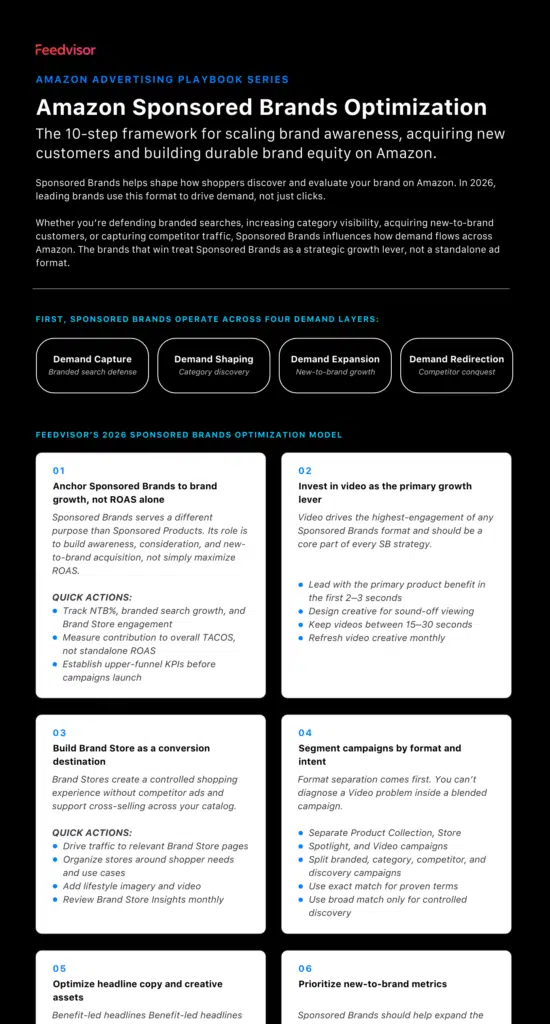
Download Your Copy of the 2026 Sponsored Brands Optimization Framework
Final Takeaway
In 2026, optimizing Amazon Sponsored Brands requires far more than headline testing and bid adjustments. It demands coordinated creative strategy, Brand Store investment, new-to-brand measurement, full-funnel integration across Sponsored Products, Display, and DSP, and portfolio-level evaluation across the entire Amazon advertising system. At scale, managing these interdependent variables manually is neither efficient nor sustainable.
Leaders use agentic technology capable of processing real-time creative performance signals, competitive share of voice data, and cross-format attribution simultaneously. Feedvisor refers to this as Agentic Commerce: an operating model built on brand-growth-first measurement, structured campaign architecture, and continuous signal integration across the retail media ecosystem.
Feedvisor’s Agentis commerce platform is built to operationalize this model, integrating marketplace, operational, brand, demand, and advertising signals into a single decision layer. Feedvisor’s AI Advisor continuously surfaces recommendations across SB bidding, creative rotation, budget allocation, and full-funnel coordination, while agentic systems execute those optimizations autonomously in real time. Available as a fully managed service or a self-managed SaaS solution, the platform gives brands and vendors the flexibility to choose how they operate the system.
This model requires a disciplined approach built on:
- Brand growth-first measurement
- Video creative investment
- Brand Store as conversion destination
- Format and intent-based segmentation
- Headline and creative optimization
- New-to-brand prioritization
- Full-funnel coordination with Sponsored Products and DSP
- Pricing and promotional alignment
- Competitive share of voice monitoring
- Portfolio-level performance measurement
Individually, these are tactics. Together, they form the operating model for how demand is created, shaped, and converted on Amazon.
Most brands use Sponsored Brands to generate traffic. High-performing brands use it to shape how demand flows, how products are discovered, and how customers evaluate the brand before conversion ever happens.
If your Sponsored Brands program is not operating on this model, you are not just under-optimizing performance, you are ceding control of how customers discover and choose your brand, sacrificing both brand equity and customer acquisition efficiency.
FAQs for Amazon Sponsored Brands
What Are Amazon Sponsored Brands?
Amazon Sponsored Brands is an Amazon advertising format that supports multiple buying models, including CPC, vCPM, and reserved placements depending on campaign objective and placement type. It drives shoppers to a Brand Store or product listing page and is Amazon’s primary format for building brand awareness, driving consideration, and acquiring new-to-brand customers.
What Is the Difference Between Sponsored Products and Sponsored Brands on Amazon?
Sponsored Products promotes individual product listings within search results and on product detail pages, optimized for demand capture and direct conversion. Sponsored Brands promotes the brand through headline-driven, product, and video creative placements across premium Amazon search environments, optimized for awareness, consideration, and new-to-brand acquisition. Most high-performing programs run both formats in coordination. Sponsored Brands builds the consideration that Sponsored Products later converts. For the complete Sponsored Products optimization framework, see Part 1 of this series.
What Are the Three Amazon Sponsored Brands Ad Formats?
The three primary Sponsored Brands formats are Product Collection, Store Spotlight, and Sponsored Brands Video. Product Collection ads combine a brand logo, custom headline, and a selectable product pool from which Amazon dynamically features the most relevant products based on shopper intent and search signals. Store Spotlight drives shoppers into specific Brand Store pages, while Sponsored Brands Video uses motion creative to capture attention directly within search results. Each format serves different strategic objectives and should be managed separately.
How Should Amazon Sponsored Brands Campaigns Be Structured?
High-performing programs separate campaigns by format, keeping Product Collection, Store Spotlight, and Video in distinct campaigns, and by intent layer, separating branded, generic category, and competitor targeting. This prevents blended performance signals, enables precise budget allocation, and creates the clean signal separation required for effective creative testing.
What Is a Good New-to-Brand Percentage on Amazon?
There is no universal benchmark. NTB% varies significantly by category, brand maturity, and campaign type. Generic and category campaigns typically show higher NTB%, often 60 to 80 percent or above in competitive categories. Branded campaigns show lower NTB% by design. The most useful benchmark is your own directional trend. Rising NTB% on generic campaigns signals effective upper-funnel expansion. Declining NTB% signals audience saturation or creative fatigue and should trigger an investigation.
How Do You Optimize Amazon Sponsored Brands Video Ads?
Lead with the core product benefit in the first two to three seconds, combine lifestyle context with clear product demonstration, optimize for mobile viewing, and design for sound-off viewing. Keep videos between 15 and 30 seconds. Rotate creative monthly to combat fatigue and run systematic A/B tests on messaging angles, product focus, and visual style. Video is the highest-engagement SB format and should receive an increasing share of budget in 2026.
Should Sponsored Brands Drive Traffic to a Brand Store or Product Page?
In most cases, driving traffic to a Brand Store is preferable. It increases basket size, enables cross-selling, and removes competitor ad visibility from the shopper experience. Store Spotlight is specifically designed to drive Brand Store engagement, while Sponsored Brands Video and Product Collection can direct traffic either to a Brand Store with featured products or to an individual product detail page, depending on campaign objective.
Brand Stores are typically better suited for discovery, consideration, and cross-category exploration, while individual product pages can be effective for hero SKUs, launches, and high-intent conversion campaigns.
How Do Sponsored Brands and Amazon DSP Work Together?
DSP builds awareness among prospecting audiences who are not yet searching for your brand or category on Amazon. Sponsored Brands captures consideration when those shoppers begin searching. Sponsored Products closes the conversion. This full-funnel model, DSP to SB to SP, is how high-performing brands coordinate advertising investment on Amazon. Amazon Marketing Cloud provides path-to-purchase data to evaluate cross-format contribution and measure SB’s true incrementality within the system.
How Is AI Changing Amazon Sponsored Brands Optimization?
AI enables real-time creative performance analysis, automated budget reallocation across SB campaigns based on performance velocity, and predictive audience targeting through AMC integration. Feedvisor’s AI Advisor surfaces actionable recommendations across SB bidding, targeting, creative rotation, and budget allocation, while agentic AI executes those decisions autonomously. This allows SB programs to adapt to competitive dynamics and demand shifts at a speed that manual management cannot match.
What Is the Role of Sponsored Brands in a Retail Media Strategy on Amazon?
Sponsored Brands is the primary brand-building format within Amazon’s retail media ecosystem. It sits between DSP, which handles upper-funnel awareness, and Sponsored Products, which handles lower-funnel conversion, driving consideration and category-level brand visibility. Leading brands treat SB not as an isolated ad format but as a critical component of a coordinated system where advertising, pricing, inventory, and promotions are aligned to margin, growth, and market share objectives.