


Categories
Latest Posts



Tags
Advertising Amazon Amazon Advertising Amazon Experts Amazon Listing Optimization Amazon Marketplace Amazon News Amazon Prime Amazon Professional Sellers Summit Amazon Seller amazon sellers Amazon Seller Tips Amazon Seller Tools ASIN Brand Management Brands Buy Box Campaign Manager Consumer Trends COVID-19 downloadable Dynamic Pricing Ecommerce FBA FBM Holiday Season industry news Multi-Channel Fulfillment Optimize pay-per-click Pricing Algorithm Pricing Software Private Label Profits Repricing Repricing Software Revenue Sales Seller Seller-Fulfilled Prime Seller Performance Metrics SEO SKU Sponsored Products Ads Strategy
Get the latest insights right in your inbox
Resource | Blog
Where Do Shoppers Actually Buy After They Research?
- October 22, 2026
By: Marissa Incitti

Shoppers have never had more places to look for a product. A TikTok video, a ChatGPT prompt, a Google AI Overview, a brand’s own site. In just a few years, the research phase of online shopping has splintered across a dozen surfaces.
So where does all that research end up?
For our 2026 Consumer Commerce Report, we asked 1,006 U.S. Amazon shoppers where they go online when they’re ready to buy a specific product. 74% said Amazon. 10% said ChatGPT.
That gap is one of the stories of this year’s data. Discovery is scattered. Conversion is not.

Marissa Incitti
Key takeaways
- 74% of U.S. Amazon shoppers go to Amazon when they’re ready to buy a specific product. 9% go to ChatGPT.
- Product discovery is spread across many surfaces, including AI tools, but purchases concentrate on Amazon and Walmart.
- Only 5% of shoppers buy immediately after an AI tool recommends a product.
- For brands, the Amazon product page is where the sale is won or lost.
Discovery happens everywhere
Ask shoppers where they start searching for a new product and the answers sprawl. Amazon still leads at 62%, but it shares the stage with Walmart (36%), Google Shopping (21%), Facebook (18%), retailer websites (16%) and brand websites (15%).
AI has joined the list, too. This is the first year we asked about AI tools as starting points, and they’re already showing up: 16% of shoppers say they start with ChatGPT, 13% with Google AI Mode, 13% with Gemini and 12% with Google AI Overviews.
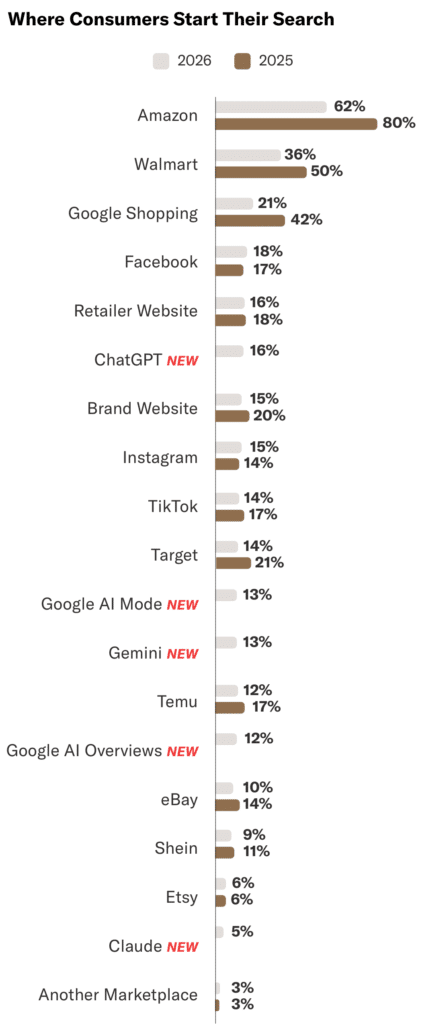
No single surface owns the first touch anymore. A shopper might see a product on TikTok, ask ChatGPT whether it’s any good and check Google Shopping before forming an opinion.
Checkout happens in one place
Now ask the same shoppers where they go when they’re ready to buy. The list collapses.
Amazon jumps to 74%. Walmart is a distant second at 42%. After that, nothing breaks 20%. Every AI tool lands in single digits: ChatGPT at 9%, Gemini and Google AI Mode at 8% each, Google AI Overviews at 6% and Claude at 4%.
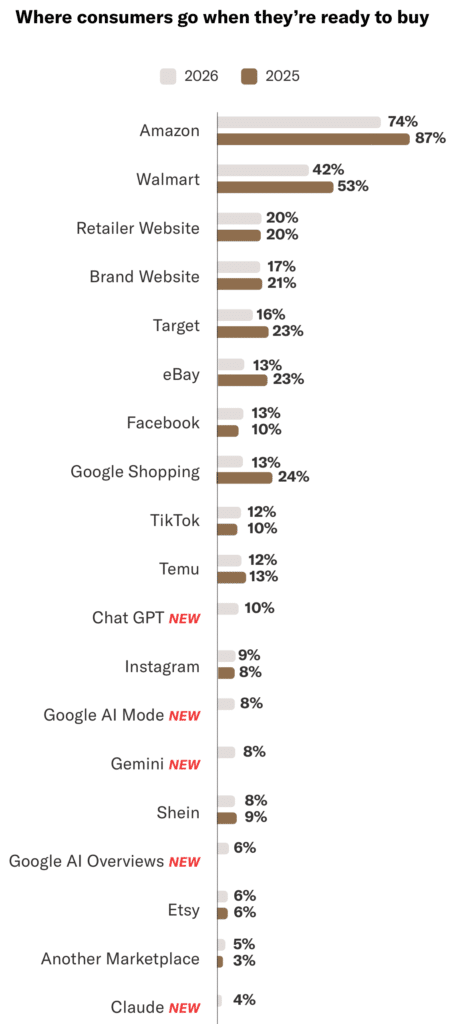
Put the two questions side by side and the pattern is hard to miss. Amazon gains 12 points between where shoppers start (62%) and where they buy (74%). Walmart gains six. Every AI surface moves the other way: ChatGPT drops from 16% to 9%, Gemini from 13% to 8% and Google AI Overviews from 12% to 6%.
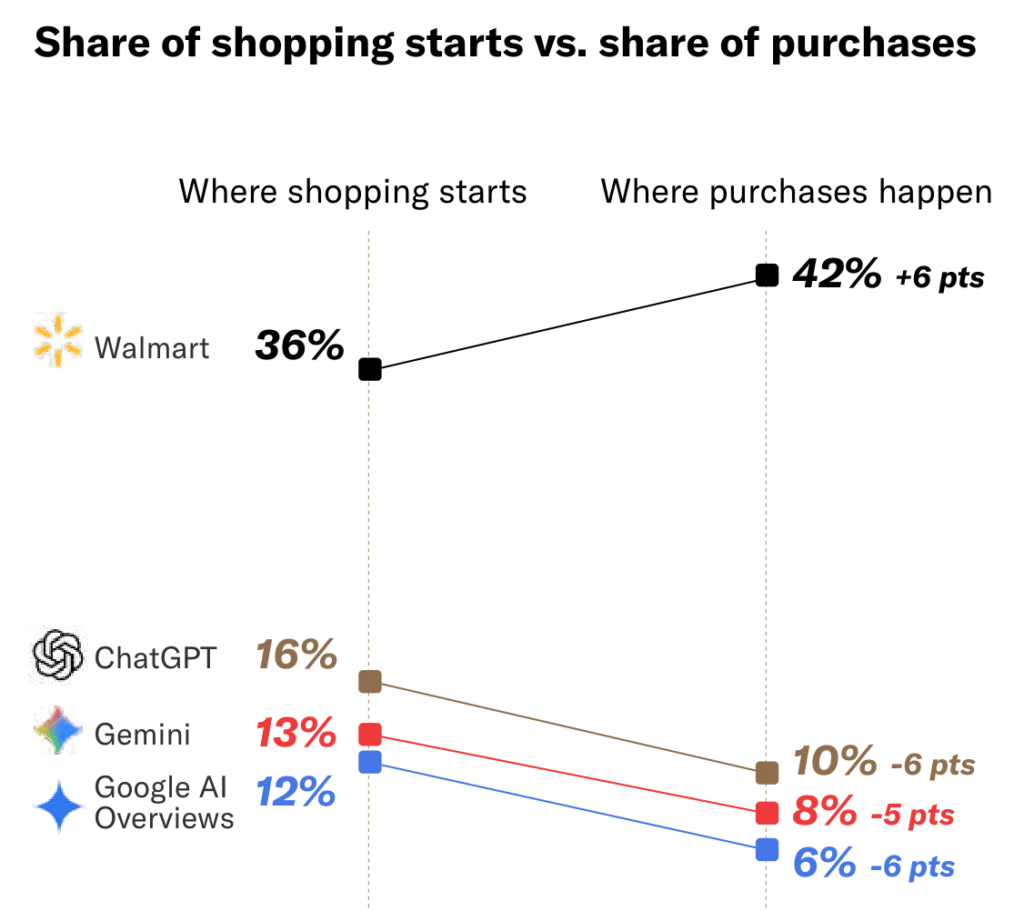
Shoppers will research almost anywhere. They buy where they already trust the checkout.
Why AI starts the sale but rarely finishes it
What happens after an AI tool recommends a product? Only 5% of shoppers say they’d buy it right away.
Everyone else goes looking for a second opinion. 24% search Google, 18% search Amazon, 17% read reviews and 17% compare alternatives. Another 19% ignore the recommendation altogether.
Shoppers are just as cautious about letting AI close the deal for them. 62% say they would never let an AI agent order and pay for something on their behalf.
The pull toward Amazon at checkout holds across generations. It’s strongest among shoppers 65 and older, 84% of whom name Amazon when they’re ready to buy. Even among 18-to-29-year-olds, the group that spreads its research widest, 59% still come back to Amazon to purchase.
What this means for brands: win the Amazon product page
Discovery is worth chasing, but it isn’t where the sale is decided. A shopper can meet your product on TikTok, hear about it from ChatGPT and price it on Google. Three out of four will still finish the job on Amazon.
That makes your Amazon product page the closing argument. It’s where every claim a shopper picked up elsewhere gets checked. Here’s what we’d focus on:
- Answer the questions shoppers bring with them. Titles, images, bullets and A+ content should confirm what an AI tool or a creator told them, not leave them guessing.
- Price for a shopper who has already compared. Most arrive having seen your price somewhere else. If yours doesn’t hold up, they notice.
- Treat reviews as the second opinion. When an AI recommendation isn’t enough, reviews are where shoppers go to settle the decision.
- Stay in stock and buyable. A shopper who arrives ready to buy and finds a gap has an easy alternative. Walmart is the second stop for 42% of them.
The brands that win in 2027 won’t be the ones that show up in the most places. They’ll be the ones whose product page closes the sale when the shopper finally arrives.
Want the full picture? Download the 2026 Consumer Commerce Report for the complete data on how shoppers search, compare and buy.
About the data
Feedvisor’s 2026 Consumer Commerce Report is based on a survey of 1,006 U.S. adults who shop on Amazon, conducted by Zogby Analytics August 4–7, 2026. Questions about where shoppers search and buy allowed multiple answers, so percentages do not add up to 100.