

Categories
Latest Posts



Tags
Advertising Amazon Amazon Advertising Amazon Experts Amazon Listing Optimization Amazon Marketplace Amazon News Amazon Prime Amazon Professional Sellers Summit Amazon Seller amazon sellers Amazon Seller Tips Amazon Seller Tools ASIN Brand Management Brands Buy Box Campaign Manager Consumer Trends COVID-19 downloadable Dynamic Pricing Ecommerce FBA FBM Holiday Season industry news Multi-Channel Fulfillment Optimize pay-per-click Pricing Algorithm Pricing Software Private Label Profits Repricing Repricing Software Revenue Sales Seller Seller-Fulfilled Prime Seller Performance Metrics SEO SKU Sponsored Products Ads Strategy
Get the latest insights right in your inbox
Amazon Product Search: How It Works and How to Rank in 2026
Published: February 27, 2017
Last updated: March 20, 2026

Marissa Incitti
Marissa Incitti leads research and content at Feedvisor focused on Amazon, Walmart, and the broader e-commerce marketplace ecosystem. Her work covers retail media performance, pricing strategy, and how AI-driven discovery is reshaping how brands compete across marketplaces. Prior to Feedvisor, she worked in content leadership roles at a Fortune Global 500 omnichannel commerce technology company.
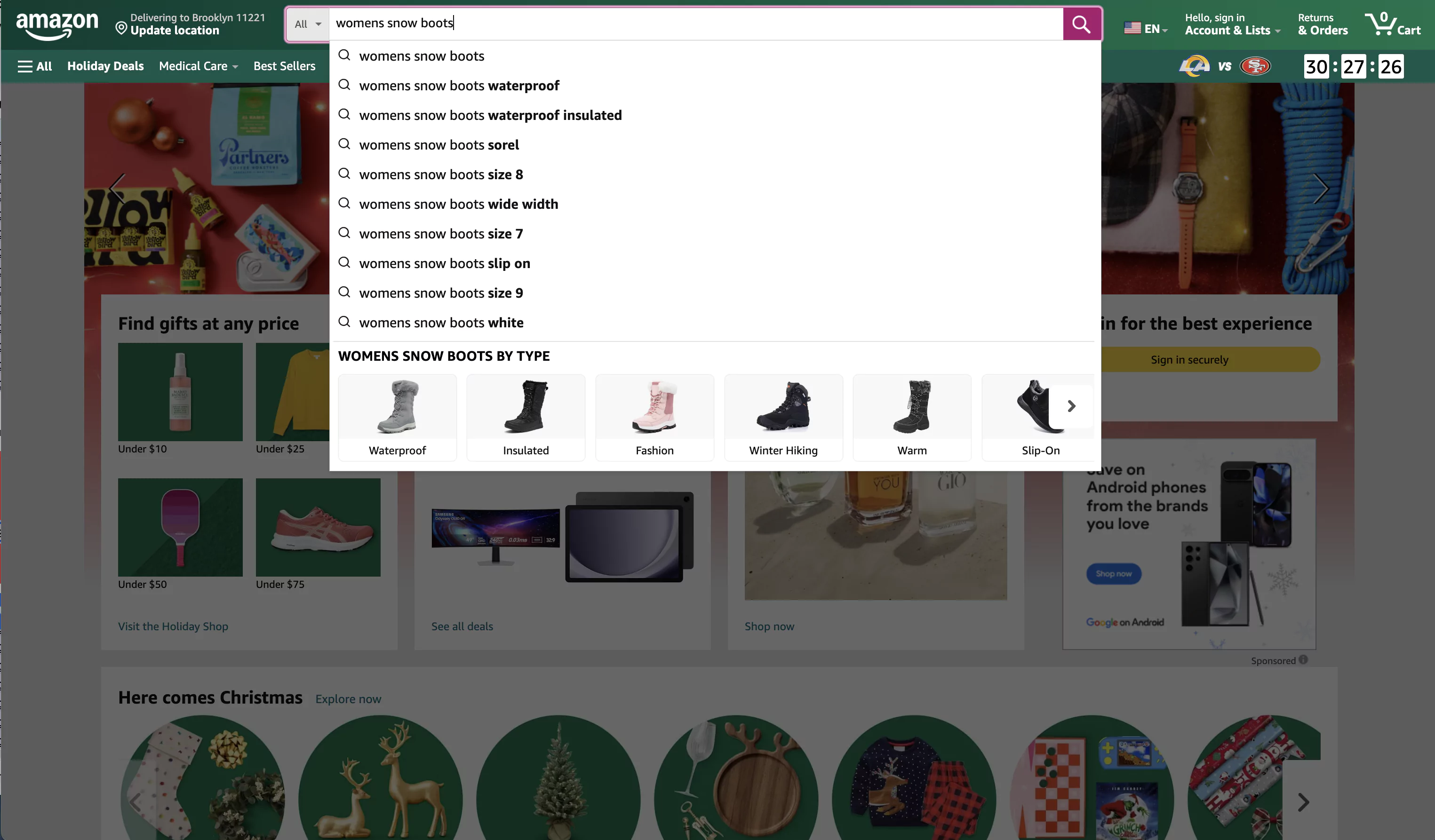
Table of Contents
- What Most Sellers Get Wrong About Amazon Search
- How Amazon’s Search Algorithm Actually Works
- COSMO: The AI Layer That Changed Everything
- Rufus and the Shift to Conversational Shopping
- The Ranking Factors That Actually Move the Needle
- Backend Search Terms: 250 Bytes You Cannot Waste
- Where Ads Fit Into Search Results
- FAQ
What Most Sellers Get Wrong About Amazon Search
Most sellers still treat Amazon search like it’s 2019: stuff keywords into your title, run some PPC, wait for the algorithm to reward you. That playbook is dead. Amazon’s search system has been rebuilt around AI models that understand intent, not just keywords, and the sellers still optimizing for exact-match phrases are watching their rankings erode while they do everything the old guides told them to.
Between 2022 and 2025, Amazon quietly rebuilt its search engine from a keyword-matching system into an intent-prediction machine. The underlying algorithm (still officially A9, though the seller community calls it “A10”) now layers semantic AI, conversational shopping, and behavioral signals on top of traditional keyword matching. The familiar Amazon search bar still sits at the top of every page, but what happens behind it has changed fundamentally. If your listing answers “what keywords did they type?” but not “what are they actually trying to buy?”, you’re already behind.
How Amazon’s Search Algorithm Actually Works
Amazon’s algorithm optimizes for one thing: the likelihood that a shopper will buy. Every ranking signal feeds that prediction.
The current system weighs these factors, roughly in order of impact:
| Factor | What It Measures | Why It Matters |
|---|---|---|
| Conversion rate | Clicks that become purchases | Direct signal of purchase intent match |
| Sales velocity | Consistent daily sales volume | Sustained demand, not promotional spikes |
| Seller authority | Feedback score, return rate, account health | Trust proxy for the seller rating |
| External traffic | Off-Amazon traffic that converts | Market validation beyond Amazon’s ecosystem |
| Click-through rate | Impressions that become clicks | Listing relevance at the search-result level |
| Review quality | Helpfulness votes, recency, credibility | Buyer confidence signal |
Two things stand out. First, organic sales now carry more ranking weight than ad-driven sales. Running PPC alone is no longer enough to build sustainable rankings - the algorithm distinguishes between a shopper who found you organically and one who clicked an ad. Second, external traffic has gone from irrelevant to significant: industry estimates put its ranking contribution at roughly 15-20%, up from near zero five years ago.
When your listing converts well from Google or social media traffic, Amazon treats that as evidence of real market demand and rewards you with better organic placement.
COSMO: The AI Layer That Changed Everything
COSMO is Amazon’s semantic AI framework, built on large language models and deployed across search relevance, recommendations, and navigation. Published by Amazon Science, it operates as an intelligence layer on top of the base search engine.
The scale is significant: a knowledge graph of 6.3 million nodes and 29 million edges connecting products, attributes, use cases, and customer needs across 18 categories. When someone searches “shoes for a wedding,” COSMO doesn’t scan for listings containing those words - it infers the buyer wants formal dress shoes and returns results accordingly.
What this means for your listings: keyword density matters less than whether your content accurately communicates what your product does, who it’s for, and how customers use it. Keyword stuffing doesn’t just fail to help anymore - it can actively harm your visibility by signaling poor user experience to the AI.
The sellers winning under COSMO structure their listings around intent. A bullet that reads “Feature -> Benefit -> Use Case” gives the system more to work with than a keyword-packed string. Discovery attributes in your product template - subject, target audience, intended use - feed directly into how COSMO categorizes your listing.
That said, keywords still matter. COSMO builds on keyword matching; it doesn’t replace it. Your title, bullets, and backend terms still need relevant search terms. The difference is that relevant, natural language outperforms mechanical keyword insertion.
Rufus and the Shift to Conversational Shopping
Over 250 million customers have used Rufus, Amazon’s AI shopping assistant, and those shoppers are 60% more likely to purchase during a session where they use it. Amazon projects Rufus will drive over $10 billion in incremental annualized sales.
Rufus processes natural language queries - “what’s a good gift for a runner under $50?” - and recommends products based on listing content, reviews, Q&As, and product data. It remembers preferences across sessions and, since late 2025, can autonomously purchase products at target prices.
For sellers, Rufus changes the optimization game. Your listing needs to answer the kinds of questions shoppers actually ask, not just match keyword strings. Products with clear use-case descriptions, specific specifications, and well-structured comparison points get recommended more often. Think of it as writing for a very well-informed salesperson who’s reading your listing out loud to the customer.
This is murkier territory - Amazon hasn’t published a Rufus optimization guide, and the system draws on review content and Q&As you don’t fully control. But what you can control is making your listing’s structured data as complete and specific as possible.
The Ranking Factors That Actually Move the Needle
Conversion rate dominates. Nothing else comes close. The average Amazon conversion rate sits around 9.8% across all categories; top-performing listings reach 15-25%. Consider two sellers competing on the same keyword: Seller A converts at 8% with no external traffic. Seller B converts at 14% and drives 600 Google sessions monthly through a product blog. Seller B’s listing signals both stronger buyer intent and independent market validation - exactly the two things the algorithm rewards most. No amount of keyword work closes that gap for Seller A until the fundamentals - images, pricing, reviews, product listing quality - are fixed.
External traffic is the factor most sellers ignore entirely. Google organic traffic carries an estimated 1.8x ranking weight compared to paid search. Even 200-300 monthly sessions from external sources produce measurable ranking improvement; above 1,000 sessions, the impact is roughly equivalent to 10-15 additional daily sales. This applies across AmazonGlobal marketplaces too. Use Amazon Attribution to track which sources actually convert. But the keyword is converts - external traffic that bounces sends a negative signal.
Your seller performance metrics function as a silent multiplier across your entire catalog. Feedback rating, order defect rate, shipping speed - Amazon uses these as a trust proxy. Slip below the thresholds and you don’t just risk loss of selling privileges; your search visibility drops across every listing you own. High returns and refund rates, or unresolved A-to-Z guarantee claims, are especially damaging. If your account faces restrictions, see the guide on appealing the removal of selling privileges. Maintain the standards outlined in Amazon’s Terms and Conditions.
Review quality matters more than count - a product with 200 reviews where 80 are marked helpful outranks a product with 500 reviews that nobody found useful. Recent 4-star reviews with detail carry more weight than old five-star ones.
Backend Search Terms: 250 Bytes You Cannot Waste
Your backend search terms get approximately 250 bytes. Exceed the limit and Amazon won’t index any of your backend terms - not just the excess. This is the single most common technical mistake sellers make with search terms.
The rules are straightforward: Amazon indexes each unique term only once across your entire listing. A keyword in your title is already indexed. Repeating it in your backend wastes bytes. Reserve this field for the 50-60 terms that don’t fit naturally in customer-facing copy: synonyms, alternate spellings, Spanish translations for the US market, and common misspellings.
Avoid competitor brand names (policy violation), subjective terms like “best” or “amazing,” and punctuation. Space-separated words only.
Pull your highest-converting keywords from your PPC search term reports and work backward: any high-performer that isn’t already in your title or bullets belongs in your backend.
If your conversion rate is below 10% and you’re getting fewer than 300 external sessions monthly, you’re paying more for ads than the algorithm will give back. Feedvisor’s AI pairs pricing and advertising optimization in one platform - see where your catalog actually stands.
Where Ads Fit Into Search Results
Sponsored Products appear at the top, middle, and bottom of search results plus on product detail pages. They deliver 2-5x higher conversion rates and 20-30% lower CPC than Sponsored Brands - your best tool for keyword-level visibility and direct sales.
Sponsored Brands occupy the banner above search results - the highest-visibility placement on the page. Better for brand awareness and showcasing multiple products, but they cost more per click and convert less directly.
PPC is no longer primarily a ranking tool. Organic conversions carry more weight than ad-driven ones. The smart play is using PPC data to discover your best-converting keywords, then incorporating those terms into your organic content to build sustainable rankings. Deploy ads for initial velocity, then let organic momentum sustain your position.
Starting March 25, 2026, Amazon is rolling out AI-powered Sponsored Prompts that automatically surface relevant product information during the shopping journey - another signal that advertising and AI-driven discovery are converging. For more on advertising metrics, see the guides on ACoS and TACoS.
FAQ
How does Amazon’s A10 algorithm differ from A9?
“A10” is community terminology - Amazon hasn’t officially renamed the algorithm. But the system has evolved substantially: it now prioritizes conversion rate and seller authority over raw keyword matching, rewards external traffic that converts, and layers semantic AI (COSMO) on top of traditional search. The biggest practical change is that organic sales weigh more than PPC-driven ones for ranking purposes.
Do backend search terms still matter in 2026?
They’re one of the few technical levers you fully control. Backend terms let you index for keywords that don’t fit in customer-facing content - synonyms, translations, high-converting PPC terms. The ~250-byte limit is strict; exceed it and nothing indexes at all.
How does Rufus affect product rankings?
Rufus doesn’t directly alter search rankings, but it influences product discovery for the 250+ million shoppers who use it. Products with clear use-case descriptions, detailed specifications, and complete structured data get recommended more often. Since Rufus users are 60% more likely to purchase, optimizing for conversational queries is increasingly a revenue driver.
What is the most important Amazon ranking factor?
Conversion rate. If your listing converts below the category average (~9.8% overall), improving keywords or running more ads will have limited impact. Fix the fundamentals first - images, pricing, reviews, listing quality - then optimize for search visibility.
Does driving external traffic to Amazon help rankings?
Only if it converts. External traffic now accounts for an estimated 15-20% of ranking weight, with Google organic carrying the highest weight (roughly 1.8x compared to paid search). Traffic that bounces sends a negative signal. Track performance through Amazon Attribution and focus on sources with genuine purchase intent.
Your Listings Are Optimized for 2019. Amazon's Algorithm Isn't.