Categories
Latest Posts



Tags
Advertising Amazon Amazon Advertising Amazon Experts Amazon Listing Optimization Amazon Marketplace Amazon News Amazon Prime Amazon Professional Sellers Summit Amazon Seller amazon sellers Amazon Seller Tips Amazon Seller Tools ASIN Brand Management Brands Buy Box Campaign Manager Consumer Trends COVID-19 downloadable Dynamic Pricing Ecommerce FBA FBM Holiday Season industry news Multi-Channel Fulfillment Optimize pay-per-click Pricing Algorithm Pricing Software Private Label Profits Repricing Repricing Software Revenue Sales Seller Seller-Fulfilled Prime Seller Performance Metrics SEO SKU Sponsored Products Ads Strategy
Get the latest insights right in your inbox
Resource | Blog
Amazon Will Pay to Be in ChatGPT, But It Still Won’t Let ChatGPT In
- September 11, 2026
By: Marissa Incitti
Amazon is piloting ChatGPT Ads inventory through Amazon DSP, letting advertisers extend campaigns into conversational experiences inside OpenAI’s assistant. Delta Vacations is among the first U.S. brands testing it. The buy runs as a managed service on CPC and CPM, includes product feed ads generated from catalogs, and is U.S.-only at launch.
Read quickly, it looks like Amazon reversing course on OpenAI. It isn’t. Amazon’s crawler blocks are still in place, which means Amazon will pay to appear in the conversation but still won’t let the conversation into its catalog. The walled garden didn’t open. Amazon just bought billboards outside the wall — and is collecting the media fee on the way through.
For brands, this adds a third surface to the two-rail model: a paid layer inside the open rail, bought with closed-rail infrastructure. Organic agent visibility and paid agent visibility are now separate line items, and only one of them is purchasable.

Marissa Incitti
What Happened
Amazon advertisers can now extend campaigns into ChatGPT as part of a new partnership with OpenAI. The specifics worth writing down:
- Bought through Amazon DSP, sold as a managed service. Amazon’s team helps set up and optimize. That’s a meaningful detail — it signals this is not yet a self-serve channel you can quietly test with a small budget.
- CPC and CPM available. Both pricing models are on the table.
- Text and image units below organic responses, with sponsored labels, consistent with how OpenAI has served ads so far. OpenAI controls all delivery decisions through its own systems.
- Product feed ads that auto-generate creative from product catalogs.
- U.S.-only pilot. Delta Vacations is among the select group testing it.
- Aggregated reporting only at this stage: impressions, clicks, cost per result, CPM, CPC.
Context for scale: ChatGPT’s ads business launched earlier this year and recently reached a $1 billion annualized revenue run rate, with tens of thousands of advertisers. Amazon runs the third-largest digital ad platform and approached $70 billion in ad revenue last year. OpenAI had previously worked with Target’s and Albertsons’ retail media networks; Amazon’s is considerably larger.
One detail I’d flag for anyone tracking the DSP landscape: OpenAI was reportedly in conversations with The Trade Desk earlier this year. It landed on Amazon instead.
What Actually Changed and What Didn’t
Back in October, I argued that commerce was splitting into two rails: an open rail, where assistants like ChatGPT handle discovery and increasingly checkout, and a closed rail, where Amazon keeps discovery, ads, and attribution inside its own walls.
Amazon buying ChatGPT inventory looks like the closed rail cracking open. Look closer and the opposite is true.
The crawler blocks are still up. Amazon’s robots.txt restrictions on OpenAI’s crawlers — the ones that handle live browsing and search — remain in force, alongside blocks on Google, Meta, Perplexity, and Anthropic. ChatGPT still cannot pull Amazon’s catalog, pricing, or reviews into an organic recommendation. The ad revenue at stake explains why.
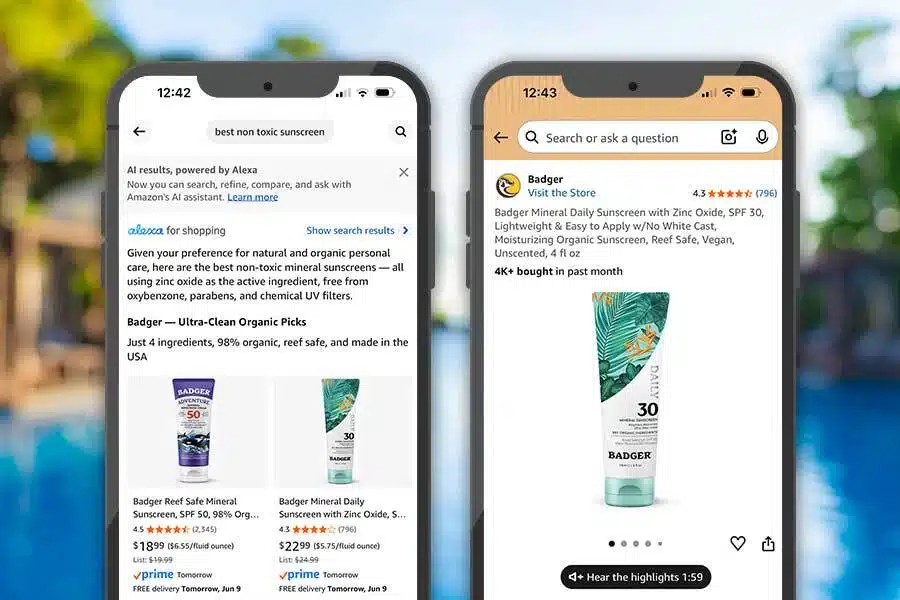
Amazon’s own agent is going the other way. In May, Amazon “retired” Rufus and folded it into Alexa for Shopping, now sitting directly in the main search bar for every signed-in U.S. shopper, no Prime, no Echo required. It ships with agentic capability, including a “Buy for Me” function that shops other retailers on the customer’s behalf. We covered what that shift does to product visibility in The Future of Amazon Advertising Isn’t Winning the Click. It’s Earning the Recommendation.
And this isn’t Amazon’s first move outward. Last year Amazon quietly added offsite placements to Sponsored Products, auto-applying a “maximize reach” setting that pushed spend beyond the marketplace. Same logic, smaller stage: capture reach off Amazon without giving up anything that happens on it.
Put those together and the strategy is consistent:
Amazon wants to be the agent everywhere. It does not want to be a data supplier to someone else’s.
Selling ad inventory inside ChatGPT fits that perfectly. Amazon monetizes a channel it can’t control organically, keeps its first-party shopping and streaming data as the targeting advantage, and gives OpenAI nothing it was previously refusing to give. The door stays locked. Amazon is now renting the doorway.
I’ll also note the prediction that aged well: in the October post, “retail media redefinition: ads embedded within AI chats and agent recommendations” was on the what-comes-next list. That took about eleven months.
The Model, Updated: A Paid Layer on the Open Rail
The two-rail framework still holds. What it needs is a third column.
| Open Rail (Organic) | Open Rail (Paid) — new | Closed Rail | |
|---|---|---|---|
| Players | ChatGPT + Walmart, Etsy, Shopify | ChatGPT Ads via Amazon DSP | Amazon / Alexa for Shopping |
| How you appear | Agent surfaces you conversationally | You buy placement beneath the answer | Amazon’s assistant surfaces you |
| Who controls it | The assistant’s retrieval and ranking | OpenAI controls delivery; Amazon controls the buy | Amazon controls everything |
| Can you buy your way in? | No | Yes | Partially, via Amazon Ads |
| What it costs you | Structured data and content work | Media spend | Both |
| The brand job | Make yourself retrievable and quotable | Test the buy, insist on measurement | Feed the assistant clean signals |
The important shift: organic and paid agent visibility are now separate disciplines with separate owners. Organic still requires the structured-content work with clear attributes, “best for” statements, disambiguated variants, seeded Q&A. Paid is a media line item. Teams that treat them as one initiative will underinvest in the harder one, which is organic.
It also adds a third place for decisions to fragment. As our president and COO, Dani Nadel, argued in Forbes, agentic commerce doesn’t fix siloed decision-making, it distributes it across more surfaces. A conversational ad buy managed apart from your pricing, inventory, and on-Amazon media is one more disconnected decision, not one more channel.
What This Means for Your Brand
If you’re an endemic Amazon brand, nothing here restores your visibility in organic ChatGPT recommendations. Your catalog is still blocked. What’s new is that you can buy a placement under the answer that doesn’t include you, which is a real workaround for a visibility gap Amazon itself created.
If you’re nonendemic (you don’t sell on Amazon) this is arguably the bigger story. Amazon’s audience and behavioral data are now usable to target conversational placements without any Amazon retail relationship. Delta Vacations is the tell: a travel brand, not a marketplace seller. That’s who the pilot is built for.
If you sell across marketplaces, your discovery strategy now has three budget lines instead of two, and the third one is priced like media, not like content ops.
What You Can Do In The Next 60 Days
- Ask your Amazon rep where you sit in the pilot queue. It’s managed service and U.S.-only, so access is gated. Knowing your position tells you whether to plan for Q4 or next year.
- Baseline your organic agent visibility first. Run your top 30 buying prompts through ChatGPT and record who gets named. You cannot evaluate paid lift without knowing the organic floor.
- Pre-negotiate measurement expectations. Aggregated impressions, clicks, CPC, CPM, and cost per result is what’s on offer today. Decide internally what “worked” means before you spend, because the reporting won’t decide it for you.
- Audit your product feed. Feed ads auto-generate assets from your catalog. Whatever inconsistency lives in your data will be rendered as creative in front of a shopper mid-decision.
- Keep funding the structured-content work. Paid placement in ChatGPT does not make you retrievable. The moment a competitor is named in the organic answer above your ad, you’ll want to have been doing both. Our guide to today’s AI shopper covers the levers assistants actually weigh.
The Honest Caveats
- This is a pilot with a handful of brands. Treat anything you read about performance, including this post, as provisional.
- Early ChatGPT Ads results have drawn mixed reviews. Industry reporting suggests some marketers have found performance underwhelming. Conversational ad formats are new enough that benchmarks are more or less unbuilt.
- Attribution in conversational commerce is still unsolved. OpenAI has been working with third parties on measurement, including a LiveRamp partnership, but the gap between “a shopper saw your unit under an answer” and “a shopper bought” remains wider here than in search or retail media.
- Managed service means less control. You are not tuning this yourself at launch.
What Comes Next
The October forecast was that ads would arrive inside AI chats. They have. The next set of questions is narrower and more practical:
- Does the pilot go self-serve? Managed service is how Amazon de-risks a launch. Self-serve is how a channel actually scales. Watch for that shift.
- Does measurement mature fast enough to survive a budget review? Conversational ads will get one or two quarters of experimental budget. After that they need attribution.
- Does Amazon ever reopen the catalog? Its subsidiary properties have been treated differently from the main marketplace, which suggests the question is still being tested internally rather than settled.
- Do other DSPs follow? OpenAI reportedly talked to The Trade Desk first. If independent DSPs get inventory, this stops being an Amazon story and becomes a channel.
The search bar is dissolving and the conversation is the new conversion and as of this week, the conversation has a rate card.
FAQ
Q: Can Amazon advertisers now buy ads in ChatGPT? A: Yes. ChatGPT Ads inventory is available through Amazon DSP as a managed service in a U.S. pilot, priced on CPC and CPM, with product feed ads that generate creative from product catalogs.
Q: Does this mean Amazon stopped blocking ChatGPT’s crawlers? A: No. Amazon’s robots.txt restrictions on OpenAI’s crawlers remain in place. ChatGPT still can’t pull Amazon’s catalog into organic recommendations. Amazon is buying ad placements, not opening its data.
Q: What do ChatGPT ads look like to a shopper? A: Text and image units appearing beneath organic ChatGPT responses with clear sponsored labels. OpenAI controls all ad delivery decisions through its own systems.
Q: Who is this best suited for? A: Nonendemic advertisers — brands that don’t typically sell on Amazon — stand to gain the most, since it gives them access to Amazon’s shopping and streaming data for targeting without a marketplace relationship. Delta Vacations is among the pilot brands.
Q: What reporting do advertisers get? A: Aggregated performance data covering impressions, clicks, cost per result, CPM, and CPC.
Q: Should brands stop optimizing for organic AI discovery now that they can buy placement? A: No. Paid placement doesn’t make your products retrievable in organic answers. The two work differently and need separate investment.
Q: What happened to Amazon Rufus? A: Amazon retired the standalone Rufus chatbot in May 2026 and folded it into Alexa for Shopping, which now sits in Amazon’s main search bar for signed-in U.S. shoppers and includes agentic purchasing features.