Categories
Latest Posts


Tags
Advertising Amazon Amazon Advertising Amazon Experts Amazon Listing Optimization Amazon Marketplace Amazon News Amazon Prime Amazon Professional Sellers Summit Amazon Seller amazon sellers Amazon Seller Tips Amazon Seller Tools ASIN Brand Management Brands Buy Box Campaign Manager Conference COVID-19 downloadable Dynamic Pricing Ecommerce FBA FBM Holiday Season industry news Multi-Channel Fulfillment Optimize pay-per-click Pricing Algorithm Pricing Software Private Label Profits Repricing Repricing Software Revenue Sales Seller Seller-Fulfilled Prime Seller Performance Metrics SEO SKU Sponsored Products Ads Strategy
Get the latest insights right in your inbox
Resource | Blog
Growth Under Pressure: Why E-Commerce Feels Harder in 2026
- February 23, 2026
By: Marissa Incitti
Look at the top-line numbers for 2025 and the picture is reassuring. Online sales grew. Retail media budgets expanded. AI tools moved from pilot to production. Investment held steady.
Look underneath them and something else is happening.
Monetization got harder. Retail media got more expensive to scale. Forecasting got less reliable. The same revenue now takes more spend, more coordination, and more scrutiny to produce, and the brands feeling it most are the ones with the most at stake.
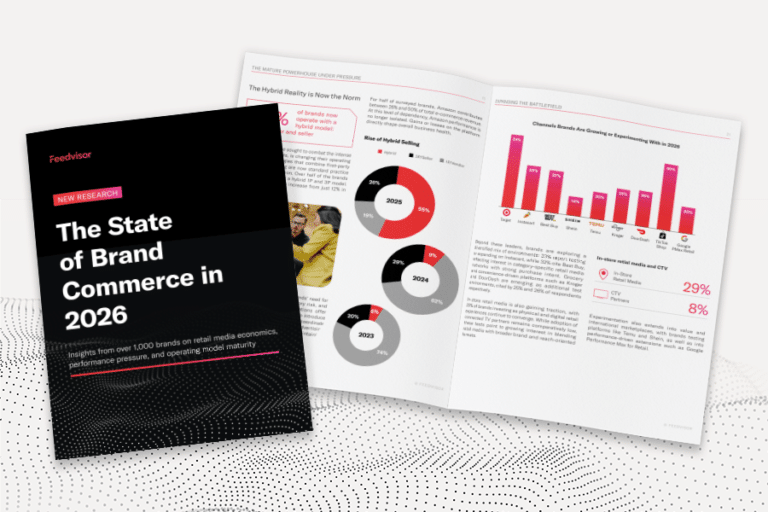
Feedvisor’s 2026 Brand Survey, conducted with Zogby Analytics among more than 1,000 retail business decision-makers, set out to explain the gap between what the headline figures say and what commerce teams are actually experiencing. This first chapter covers the market conditions creating that gap: flattening retail growth, structural media inflation, tariff-distorted demand, and acquisition economics that no longer work the way they did three years ago.

Marissa Incitti
The Headline Numbers Look Fine. The Mechanics Don’t.
Retail e-commerce continues to grow in absolute terms. In 2025, total global e-commerce sales reached approximately $6.01 trillion, a 6.86% increase over 2024.
But growth in nominal sales is not the same as growth that is sustainable, margin-positive, and driven by genuine demand expansion. Many brands and analysts describe 2025’s acceleration as the latter kind — real on the surface, but propped up by macroeconomic timing effects rather than by more customers buying more products at healthy margins.
That distinction is the entire story of 2026 planning. Volume that arrives at a loss is not the same asset as volume that arrives at a profit, and increasingly, brands are being asked to tell the difference.
The Macro Backdrop: Retail Growth Is Flattening
The broader U.S. retail context underscores the tension. According to recently released census data, overall U.S. retail sales growth in 2025 was a modest 3.7% — a pace that implies slower real-term expansion once inflation and policy headwinds are factored in.
Two external pressures are doing most of the moderating:
- Inflationary pressure continues to erode consumer purchasing power, keeping price sensitivity elevated across categories.
- Federal policy dynamics, particularly around tariffs and trade, have introduced persistent uncertainty into planning and pricing for brands of every size.
E-commerce is still taking share of the total retail pie, and that trend is intact. But the rate of expansion is decelerating even as the channel matures:
| Year | U.S. retail e-commerce sales | YoY change | % of total retail sales |
| 2022 | $1.043T | 8.6% | 14.7% |
| 2023 | $1.148T | 10.0% | 15.6% |
| 2024 | $1.268T | 10.5% | 16.7% |
| 2025 | $1.405T | 10.8% | 17.9% |
| 2026 | $1.559T | 11.0% | 19.2% |
| 2027 | $1.736T | 11.3% | 20.7% |
Table Data Source: eMarketer
The channel keeps growing. What’s changed is how much it costs to participate in that growth.
Tariffs, Timing, and the Illusion of Volume Gains
One of the most significant near-term influences on e-commerce volume last year was tariff uncertainty. As higher tariff rates loomed, many consumers pulled purchases forward in anticipation of rising prices, temporarily inflating online order volumes.
At the same time, shopping behavior itself shifted. Consumers gravitated toward discounted goods and essential categories, concentrating spend where value felt most defensible. Purchase timing became more tactical, with buying decisions clustered around promotional moments and major sales events rather than spread evenly across the year.
The combined effect was flattering in the data and misleading in practice. Demand that appeared to be growth was often demand that would have occurred anyway, just at a different time and pulled forward at a discount. For brands building 2026 forecasts off 2025 actuals, that distinction matters enormously.
Media Inflation Is Structural, Not Cyclical
Beyond rising cost of goods and general inflation, brands now face sustained media inflation. As more advertisers compete for finite attention across retail media, search, social, and streaming, the cost of visibility has structurally increased.
The year-over-year movement in core advertising KPIs makes the pattern clear:
| Metric | YoY change |
|---|---|
| Cost per click (CPC) | +12.88% |
| Conversion rate (CVR) | +6.84% |
| Cost per lead (CPL) | +5.13% |
| Click-through rate (CTR) | +3.74% |
Source: WordStream
Note the asymmetry. Conversion rates and click-through rates improved, meaning campaigns got better at their jobs, but CPCs rose nearly twice as fast as CVR. Performance improvements are being absorbed by auction costs before they reach the P&L.
This is the part brands most often misdiagnose. Customer acquisition is getting more expensive not because of short-term auction volatility, but because paid exposure is increasingly required just to drive and defend baseline demand. Media inflation is now embedded in the operating landscape, compounding margin pressure across the entire commerce stack.
Brands Are Choosing Efficiency Over Pure Growth
Faced with constrained growth and rising acquisition costs, brands across every vertical are reprioritizing. When asked to name their primary focus for the year ahead:
- 27% cited disciplined efficiency, measured through tighter TACoS control
- 21% cited customer loyalty and retention
- 21% cited profitability
Together, roughly seven in ten brands named a margin or retention objective ahead of raw scale. That’s a meaningful reordering for a channel that spent the last decade optimizing for growth at nearly any cost.
The Math Behind the Shift: A $29 Loss Per New Customer
The recalibration is happening against a stark economic reality. Customer acquisition costs have risen by nearly 60% over the past several years, fundamentally rewriting the unit economics of growth.
Today’s merchants lose an average of $29 for every new customer acquired.
In many categories, the first transaction no longer covers the acquisition investment. Layer in returns, discounts, and fulfillment, and margin erosion accelerates quickly.
The traditional answer to a negative first-purchase margin is lifetime value: acquire at a loss, recover on repeat. But that path has narrowed too. Brand loyalty has declined 5% since 2024, falling to 29% overall — the first drop in five years, according to SAP. That erosion reflects heightened price sensitivity, greater assortment parity across marketplaces, and the ease with which shoppers now switch brands based on availability, promotions, or algorithmic recommendation.
Put plainly: brands are paying more to acquire customers who are less likely to stay.
When first purchases frequently lose money and repeat behavior is less predictable, growth without discipline stops being growth. It’s just cost acceleration with a revenue line attached.
What This Means for 2026
The environment hasn’t contracted. It’s tightened. Growth is still available, but it now belongs to organizations that can operate with discipline, alignment, and validated impact rather than spend volume alone.
That reframes the central question for commerce teams. It’s no longer how much should we invest to grow? It’s which dollars are actually creating incremental demand, and are they worth the margin they consume?
Answering that requires advertising, pricing, inventory, and audience strategy to function as connected variables rather than separate workstreams. When they’re aligned, they produce stability and compound returns. When they’re siloed, they magnify cost and unpredictability, which is exactly the widening performance gap the 2026 Brand Survey found across its respondent base.

Read the full research
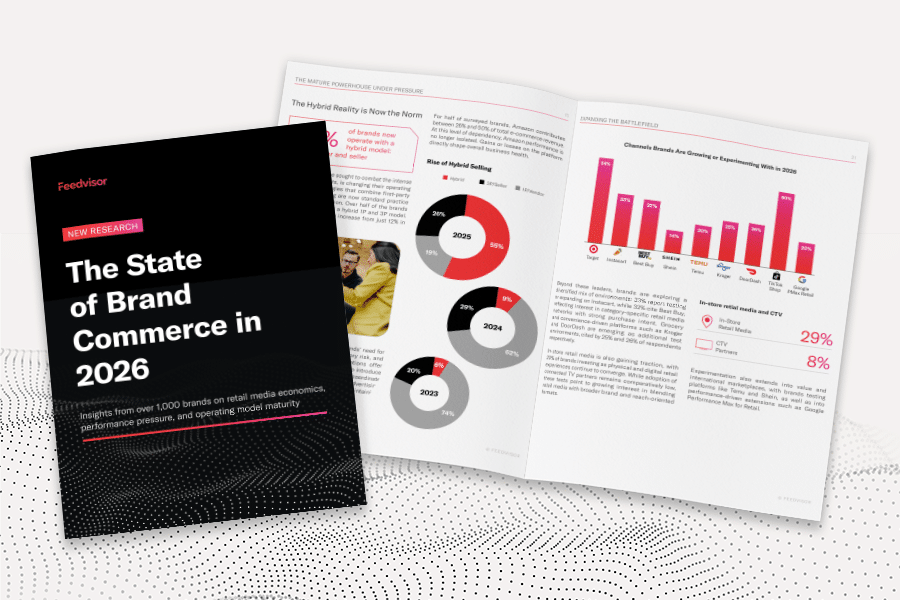
This article is Chapter 1 of The State of Brand Commerce in 2026, Feedvisor’s annual survey of more than 1,000 retail business decision-makers. The complete report covers Amazon dependency and concentration risk, retail media in a constrained system, full-funnel channel expansion, the measurement reckoning, and the operating model brands are building for an agentic future.